



The Challenge of Faint Light
Galaxies are incredibly vast, but from our perspective on Earth, they are extraordinarily faint. The light from a distant galaxy, like Andromeda, has traveled for millions of years to reach us. By the time it arrives, the signal is incredibly weak. If
you were to point a standard camera at a galaxy and take a quick snapshot, you would capture almost nothing. The sensor simply cannot gather enough light in a fraction of a second to register the galaxy's delicate structure. This is where the first key technique comes into play: long exposure.
Gathering Ancient Light, One Photon at a Time
Think of a camera's sensor as a bucket in a light rain. A quick exposure is like holding the bucket out for only a second—you’d barely collect any water. A long exposure is like leaving the bucket out for several minutes, or even hours. By keeping the camera's shutter open for an extended period, the sensor can accumulate photons, the particles of light, from the distant galaxy. The longer the exposure, the more light is gathered, and the more of the galaxy’s faint structure becomes visible. This allows features like spiral arms, dust lanes, and star-forming regions, which are invisible to the naked eye, to gradually emerge from the darkness.
The Power of Many Images
While a single long exposure can reveal a galaxy, it also introduces a problem: noise. This digital noise can come from the camera's own electronics or heat, and it appears as a grainy texture that can obscure fine details. To overcome this, astrophotographers use a technique called 'stacking' or 'integration'. Instead of taking one extremely long exposure (which also risks issues like satellite trails or mount tracking errors), they take many shorter exposures—often lasting anywhere from one to ten minutes each. These individual shots are called 'subframes'. Some astrophotographers spend dozens or even hundreds of hours capturing data for a single target.
Digital Magic: Stacking for Clarity
Once dozens or hundreds of subframes are collected, they are loaded into specialized software. The software aligns all the images, using the stars as reference points to ensure everything lines up perfectly. It then averages all the frames together. Because the light from the galaxy (the 'signal') is constant in every frame, it gets reinforced. The digital noise, however, is random. When averaged, this randomness cancels itself out, making the noise fade away while the galaxy’s details become clearer and smoother. The result is a final image with a much higher 'signal-to-noise ratio', producing a clean, detailed, and vibrant portrait of the galaxy.
Revealing the Invisible Universe
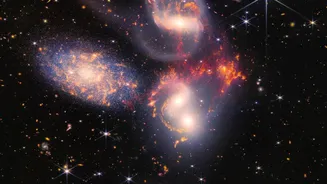
Combining long exposures with powerful optical telescopes and sophisticated stacking software unlocks a universe that is otherwise hidden from us. This method allows us to see the intricate spiral arms of galaxies like Messier 106, the glowing star-forming regions in the Triangulum Galaxy, and the sheer scale of our neighbour, the Andromeda Galaxy. It’s a testament to how technology and patience can peel back the darkness of space, revealing the stunning and complex structures that populate our cosmos. What was once the exclusive domain of massive observatory telescopes is now accessible to dedicated amateur astronomers in their own backyards, all thanks to these powerful techniques.