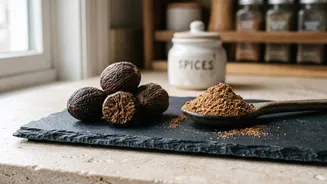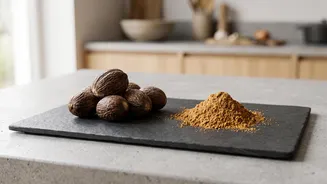






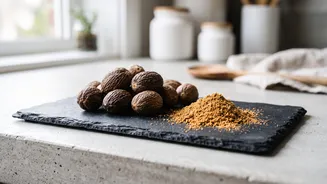


The Tradition: A Spice for Health
In India, nutmeg holds a cherished spot in both the kitchen and the medicine cabinet. Ayurvedic and Unani systems have long valued it for a range of properties. Traditionally, it's been used to aid digestion, relieve bloating, act as a sleep aid, and even
soothe joint pain. A pinch in warm milk before bed is a common household remedy for sleeplessness, passed down through generations. These uses are rooted in centuries of observation and cultural practice, where the spice is respected for its warming and calming qualities. Its role in traditional systems like Ayurveda is often to help balance the body's 'Vata' and 'Kapha' doshas.
The Science: What's Inside Nutmeg?
Modern science allows us to look inside this aromatic seed and understand what might be behind its reputed effects. Nutmeg is rich in bioactive compounds, including antioxidants that help protect our cells. The main players in its chemical profile are volatile oils like myristicin, elemicin, eugenol, and safrole. These compounds are responsible for nutmeg’s distinct aroma and flavour, and they have been studied for various potential pharmacological activities, including anti-inflammatory, antimicrobial, and antioxidant effects in laboratory settings. Myristicin, in particular, is known for its psychoactive and sedative properties, which explains both its traditional use as a calming agent and its potential for toxicity at high doses.
Claim vs. Reality: The Sleep Aid
The belief that nutmeg promotes sleep is one of its most popular claims. Traditional wisdom suggests its calming effect on the nervous system can help with insomnia. Some modern studies and reviews note that nutmeg does contain compounds with sedative qualities, such as myristicin, which may contribute to a feeling of relaxation. However, the evidence supporting it as a clinical treatment for insomnia is weak. Most support comes from animal studies or is based on its traditional reputation. Critically, large-scale human clinical trials—the gold standard for medical proof—are lacking. So, while a pinch in milk might be a comforting ritual with a mild sedative effect, it's not a scientifically validated cure for sleep disorders.
Claim vs. Reality: The Digestive Soother
Another long-standing use for nutmeg is in aiding digestion, believed to stimulate digestive enzymes and reduce issues like bloating and gas. Scientific interest in this area has focused on nutmeg's potential antimicrobial and anti-inflammatory properties. Lab studies have shown that nutmeg extracts can fight certain bacteria, including some that affect oral and gut health. Its anti-inflammatory action could theoretically soothe the digestive tract. But again, this is where the line between 'potential' and 'proven' becomes important. These findings come primarily from in-vitro (test tube) or animal studies. There is not enough robust evidence from human trials to recommend nutmeg as a reliable treatment for digestive ailments.
The Crucial Difference: Lab vs. Life
This is the core of the issue. When a study finds that a compound from nutmeg has an anti-inflammatory effect in a petri dish or reduces anxiety in rats, it is a promising first step, not a final conclusion for humans. 'Clinical effectiveness' requires rigorous testing in people through multiple phases of trials to confirm that a substance is not only effective but also safe at a specific dose for a particular condition. Many substances that show promise in the lab fail to deliver the same results in complex human bodies. Therefore, while traditional use provides a valuable starting point for research, it does not substitute for clinical evidence.
A Warning: The Danger in High Doses
It's crucial to remember that with nutmeg, more is not better. The same compound that may offer mild calming effects, myristicin, is a potent toxin in large quantities. Consuming as little as 5 to 10 grams (about one to two teaspoons) of ground nutmeg can cause serious toxicity. Symptoms can include nausea, rapid heart rate, dizziness, and distressing psychoactive effects like hallucinations. In very high doses, or when mixed with other substances, it can lead to organ failure and has even been linked to fatalities. The safe dose is the small amount used in cooking—a pinch here or a quarter teaspoon there is perfectly fine and adds wonderful flavour.