




The Sun's Fiery Outbursts
Solar flares and coronal mass ejections (CMEs) are colossal explosions of energy and plasma from the Sun's atmosphere. A single CME can release a billion tons of material, traveling outwards at hundreds of kilometres per second. When these eruptions are aimed
at Earth, they can have significant consequences. They can trigger spectacular auroras but also disrupt GPS navigation, damage satellites, and even threaten electrical power grids on the ground. For decades, scientists have understood that these events are driven by the Sun's powerful magnetic field, but tracing that field to its ultimate source requires a journey deep into the solar interior.
A Journey to the Sun's Interior
The Sun isn't a solid ball of fire; it's composed of distinct layers. At the center is the core, where nuclear fusion generates energy. This energy travels outward through the vast Radiative Zone, a region so dense it takes photons thousands of years to pass through. The outermost 30% of the Sun's interior is the Convection Zone, a churning, boiling sea of hot plasma where energy is carried to the surface through massive currents, much like a pot of boiling water. Between the calm, solid-body rotation of the radiative zone and the chaotic, churning convection zone lies a remarkably thin but crucial boundary layer. This is the tachocline.
What is the Tachocline?
The tachocline is a transitional layer, estimated to be less than 5% of the Sun's radius thick. Its defining feature is an immense shear of speed and rotation. The radiative zone below it rotates like a solid ball, with a uniform speed. The convection zone above it, however, rotates differentially—meaning the Sun's equator spins faster than its poles. The tachocline is the region where these two dramatically different rotation styles meet, creating incredible friction and turbulence. First theorized in 1992, its existence was soon confirmed by helioseismology, the study of how sound waves travel through the Sun. Scientists now believe this zone of intense shear is the cradle of the Sun's magnetic activity.
The Sun's Magnetic Dynamo
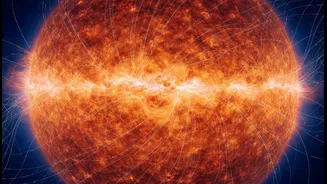
The immense shearing forces within the tachocline are believed to be the heart of the solar dynamo—the process that generates the Sun's massive magnetic field. Think of it as a giant, cosmic generator. The motion of the electrically charged plasma (the fluid) through an existing magnetic field induces powerful electric currents. The differential rotation within the tachocline takes the Sun’s relatively weak north-south (poloidal) magnetic field lines and stretches, twists, and amplifies them, creating immensely powerful, wound-up east-west (toroidal) fields. This process transforms kinetic energy from the Sun's rotation into magnetic energy.
From Deep Engine to Surface Eruption
These powerful, rope-like tubes of magnetic field, generated and intensified in the tachocline, become buoyant. They eventually rise through the 200,000-kilometre-thick convection zone and breach the Sun's visible surface, the photosphere. Where these magnetic loops poke through, they create cooler areas we see as sunspots. Solar flares and CMEs occur when these complex, twisted magnetic field lines above sunspots become unstable. They snap and reconfigure into a simpler state, violently releasing an enormous amount of stored magnetic energy in the process. In this way, the dynamic processes in the unseen tachocline are directly responsible for the dramatic solar activity we observe from 93 million miles away.