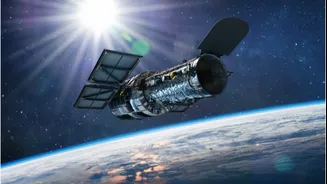







For over three decades, the Hubble Space Telescope has been humanity's eye on the cosmos. Now, the iconic observatory is losing altitude, and NASA is turning to the commercial space industry for a lifeline in an unprecedented move.
An Icon in a Slow Descent
Since its launch in 1990,
the Hubble Space Telescope has revolutionized our understanding of the universe, delivering breathtaking images and groundbreaking science. But after 36 years, the legendary observatory is facing a fundamental problem: it's slowly falling. Orbiting in low Earth orbit, Hubble experiences minuscule but constant atmospheric drag that causes its orbit to decay. Without its own propulsion system, it has always relied on external help. During the Space Shuttle era, astronauts performed five servicing missions, not only repairing and upgrading the telescope but also providing periodic boosts to a higher altitude. The last reboost occurred in 2002. With the shuttle fleet retired since 2011, Hubble's orbit has been shrinking, dropping from its post-launch altitude of over 600 kilometers to its current height of around 480 kilometers. If nothing is done, NASA predicts it could make an uncontrolled reentry into Earth's atmosphere between 2033 and 2034.
A Call for Commercial Solutions
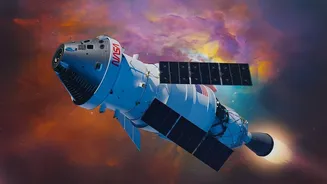
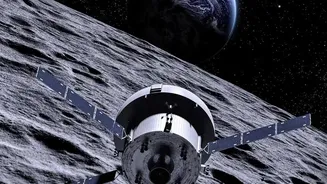
In response, NASA's Goddard Space Flight Center has issued a formal Request for Information (RFI), officially inviting the private sector to pitch ideas to save the telescope. This isn't a funded contract yet, but rather a market survey to see what's possible. The RFI, with responses due by November 30, 2026, outlines three potential missions for a commercial partner to undertake by a 2032 deadline. The first, and most hoped-for, option is an orbital reboost, where a robotic or crewed vehicle would dock with Hubble and push it to a more stable orbit of at least 600 kilometers. The second option involves a servicing mission to enhance its capabilities. The final option is a controlled deorbit, safely guiding the telescope to a disposal in a remote part of the ocean to mitigate risks from falling debris.
Who Could Answer the Call?
This RFI is a significant opportunity for the burgeoning satellite-servicing industry, which is projected to become a multi-billion dollar market by the end of the decade. Companies like Northrop Grumman, with its Mission Extension Vehicle (MEV) that has already successfully docked with and extended the life of other satellites, are established players. A host of newer companies, such as Astroscale and Starfish Space, are also developing technologies for in-orbit services like debris removal and refueling. A key name in the conversation is SpaceX. In 2022, NASA and SpaceX conducted a joint study, as part of the privately funded Polaris Program, to assess the feasibility of using a Dragon spacecraft to service and reboost Hubble. While NASA did not proceed with that specific plan at the time, this new, broader request opens the door for a revised proposal from SpaceX or other launch providers.
A Test Case for a New Space Economy
A commercial mission to Hubble would be more than just a repair call; it would be a landmark moment for the future of space operations. Such a mission presents immense technical challenges, as any vehicle would have to rendezvous with and capture a telescope that was not designed for it, all without causing damage. However, a successful mission would prove the business case for a whole new market of in-orbit servicing, assembly, and manufacturing. It would demonstrate that valuable space assets can be maintained and upgraded commercially, rather than being discarded. This shift from government-led missions to public-private partnerships could extend the lives of countless future satellites, reduce the growth of orbital debris, and make space operations more sustainable and cost_effective.