


The Universe's Greatest Mystery
Imagine throwing a ball into the air. You expect gravity to pull it back down. But what if, after slowing down, it suddenly started shooting upwards faster and faster on its own? That’s essentially what our universe is doing. For decades, astronomers
have known the universe is expanding. More recently, they discovered this expansion is accelerating. The cause is a phenomenon dubbed 'dark energy', an invisible, unexplained force that makes up about 70% of the cosmos and works against gravity. Understanding dark energy is one of the single biggest challenges in modern physics.
An Unusual Telescope Listens In
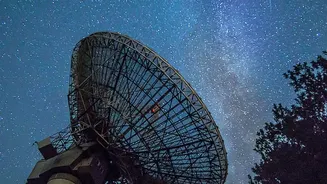
Enter the Canadian Hydrogen Intensity Mapping Experiment, or CHIME. Located in British Columbia, Canada, this is not your typical dish-shaped telescope. It consists of four massive, stationary cylindrical reflectors, each shaped like a snowboarding half-pipe. Instead of pointing and tracking specific objects, CHIME surveys the entire northern sky every single day as the Earth rotates. Its main purpose was to map the distribution of hydrogen across cosmic history to measure the universe's expansion, and it has recently achieved a major milestone.
Tuning Into Hydrogen's Hum
Hydrogen is the most abundant element in the universe, the raw material for stars and galaxies. Neutral hydrogen gas emits a very faint radio signal at a specific wavelength (21 cm). As the universe expands, this signal gets stretched to longer wavelengths by the time it reaches us. CHIME is designed to detect these faint, stretched signals. This technique, called 'hydrogen intensity mapping', allows scientists to create a 3D map of how matter was distributed billions of years ago. It’s like listening to the faint hum of the cosmos to understand its structure.
A Breakthrough in Cosmic Cartography
The major breakthrough is that the CHIME collaboration has now detected the faint glow of hydrogen from when the universe was about five billion years old using only its own data. Previously, this kind of research required cross-referencing observations with other, more expensive galaxy surveys. By successfully isolating this incredibly weak signal from overwhelming background noise, researchers proved the technique CHIME was built for actually works on its own. This standalone detection is a crucial 'proof of concept' that opens up a new, faster, and more cost-effective way to chart the universe.
A New Toolkit for an Old Puzzle
While this discovery doesn't solve the mystery of dark energy just yet, it provides a powerful and independent new way to test the theories about it. By creating vast maps of hydrogen distribution over different periods of cosmic history, scientists can measure the expansion rate of the universe with greater precision. These measurements can be compared to different models of dark energy to see which one fits best. The CHIME team has already collected seven years of data and hopes to probe even further back in time, to when the universe was just three billion years old. This will give cosmologists an unprecedented look at the era when dark energy's influence began to dominate.