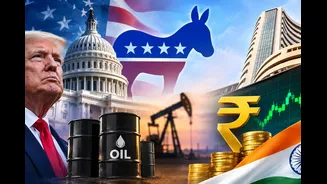







The US midterm elections are over, ushering in a new era of divided government in Washington. For global investors, including those in India, this political shift raises crucial questions about market stability, policy, and economic growth.
A New Balance of Power in Washington
The 2026 US
midterm elections have resulted in a significant power shift, with the Democratic party gaining control of both the House of Representatives and the Senate. This outcome creates a 'divided government,' where the party controlling the White House is different from the party controlling Congress. For the next two years, any new legislation will require agreement between the President and the opposition-led chambers. This scenario fundamentally changes the political dynamic, making it much harder for the administration to push through sweeping policy changes without bipartisan support. The result is often legislative gridlock, where ambitious agendas are stalled, and political battles over budgets and appointments become more frequent and intense.
Why Markets Can Prefer Gridlock
Intuitively, political gridlock sounds negative. However, financial markets often react positively to this kind of stalemate. The reason is that gridlock reduces the likelihood of major, disruptive policy overhauls, such as significant tax changes or new industry regulations. This predictability is valuable to investors, who generally dislike uncertainty. Historical data shows that markets have often performed well following midterm elections that result in a split government. While some analysts note that unified governments have sometimes produced slightly higher returns, the removal of election uncertainty and the prospect of a stable, if slow, policy environment often provides a near-term boost to equities. However, this stability comes with its own risks, particularly the increased chance of contentious debates over the US debt ceiling, which could trigger market volatility if not resolved in a timely manner.
The President's Veto Takes Centre Stage
In a divided government, the president's veto power becomes a critical tool. Granted by the US Constitution, a veto allows the president to reject a bill passed by Congress, preventing it from becoming law. Since 1981, the overwhelming majority of presidential vetoes have occurred during periods of divided government. Overriding a veto is difficult, requiring a two-thirds majority vote in both the House and the Senate, a high hurdle that is rarely met. This power dynamic means the president can effectively block the opposition's legislative agenda. The threat of a veto alone is often enough to force negotiations and compromises, shaping policy outcomes even without new laws being passed. However, it also means that crucial functions of government, like passing budgets, can become battlegrounds, sometimes leading to temporary government shutdowns.
Global Ripples and the India Connection
The political shifts in Washington have a ripple effect on global economies, including India's. A divided US government can influence global borrowing costs, trade policy, and investment flows. For India, a key area to watch is US trade policy. While a deadlocked Congress may prevent new, broad tariffs, sector-specific actions could still emerge, particularly concerning pharmaceuticals and electronics. The strength of the US dollar is another critical factor; changes in US fiscal and monetary policy can affect the rupee's value, impacting India's import costs and the profitability of its vital IT and pharmaceutical export sectors. Furthermore, a divided government could increase scrutiny on immigration rules, although major policy changes are unlikely. Finally, sectors like technology and AI, which have been a focus of recent policy, could face increased regulatory oversight from a Congress controlled by the opposition.