

A Cosmic Cigar, Revealed
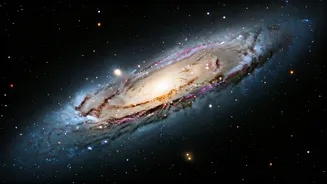
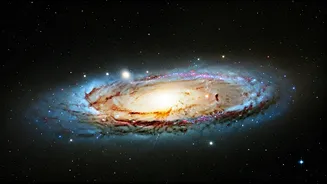
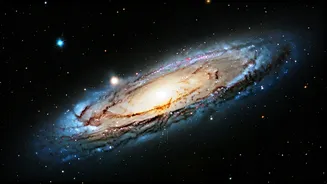
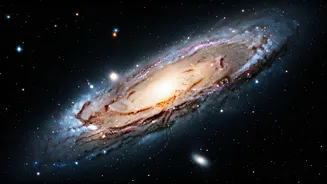
The source of this astonishing number is Messier 82 (M82), famously known as the Cigar Galaxy. Located about 12 million light-years away, it’s a close neighbour in cosmic terms. M82 is a special type of galaxy known as a 'starburst galaxy'. This means
it is creating new stars at a furious pace—about ten times faster than our own Milky Way. For decades, astronomers have studied M82 with other powerful instruments like the Hubble Space Telescope. However, the galaxy is choked with thick lanes of cosmic dust, which act like a veil, scattering visible light and hiding the galaxy's true heart. This is where the James Webb Space Telescope (JWST) changes the game.
Webb's Infrared Advantage
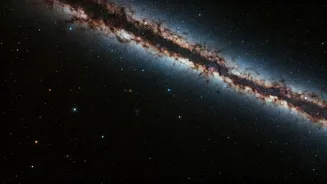
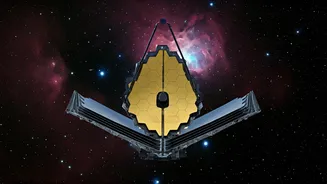
Unlike Hubble, which primarily sees the universe in visible and ultraviolet light, Webb is designed to see in infrared. This unique capability allows it to peer directly through the dense clouds of dust that would otherwise block the view. In a dedicated survey that involved 65 hours of observation time with its Near-Infrared Camera (NIRCam), Webb pierced M82's dusty shroud. The result is an image of unprecedented clarity, resolving the diffuse glow that other telescopes saw into millions of distinct points of light. Each one of those points is a star. The final tally from this deep look: approximately 16.5 million individual stars.
More Than Just a Number
Counting stars might sound like a simple inventory task, but for astronomers, it’s a revolutionary tool for understanding the universe. This detailed star count helps scientists create a map of the stellar population of M82. It's important to note that this is not the galaxy's full population; it's the number of stars Webb was able to individually resolve, with many more being too faint or crowded to separate. By analysing the distribution, brightness, and types of these 16.5 million stars, researchers can reconstruct the history of this chaotic galaxy. They can investigate how the intense burst of star formation started and how it impacts the galaxy's evolution.
A Beautiful, Distorted Mess
The Webb image confirms that M82 is not a neat, orderly spiral like our own galaxy. Its shape is distorted and uneven, likely the result of a past gravitational run-in with a neighbouring galaxy. This interaction is believed to be the trigger for its current 'starburst' phase. Webb's detailed view allows astronomers to see how this burst is propagating through the galaxy, creating massive outflows of gas and dust. This a relatively short-lived, violent phase in a galaxy's life, estimated to last only a few hundred million years. Studying M82 provides a natural laboratory for understanding these critical, high-energy events that shape the cosmos.