

A New Era of Cosmic Investigation
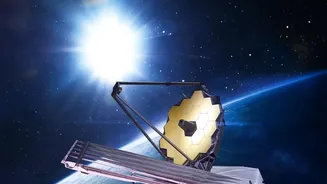
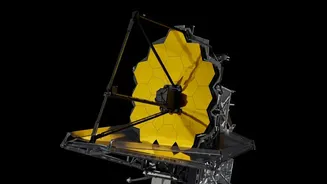
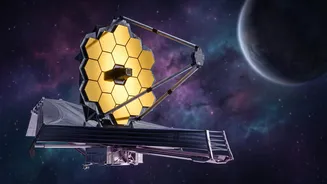
Since becoming operational, the James Webb Space Telescope has been revolutionizing astronomy, providing insights into the universe with unprecedented speed and clarity. Its powerful instruments are designed not just to take stunning images, but to dissect
the light from faraway stars and galaxies, giving us detailed information about their chemical makeup. This capability is now being turned towards exoplanets—planets outside our solar system. For years, telescopes like the Hubble have studied the atmospheres of gas giants, but the smaller signatures from rocky planets have been much harder to detect. The JWST's superior sensitivity is finally pushing past that barrier, opening a new frontier in the search for worlds that might look something like our own.
The Challenge of Finding Water
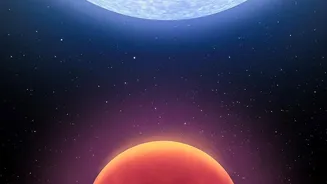
One of the most significant recent findings involves the detection of water vapor in the atmospheres of distant exoplanets. Water has been found before, but often on large, gassy planets not suitable for life as we know it. The new challenge is to find it on smaller, rocky worlds. One such candidate is GJ 486 b, a rocky exoplanet orbiting a red dwarf star about 26 light-years away. Observations from the JWST showed a signal that was almost certainly water. However, science is rarely simple. The researchers have been careful to note a significant complication: the water signature might not be coming from the planet itself, but from its host star. Cool starspots on the surface of the red dwarf can also contain water vapor, which could create a signal that mimics a planetary atmosphere.
How Webb Reads an Atmosphere
So how does a telescope 1.5 million kilometers from Earth read the air of a planet dozens of light-years away? The primary method is called transit spectroscopy. When an exoplanet passes in front of its star from our point of view, a tiny fraction of the starlight filters through the planet's atmosphere. Different molecules in that atmosphere absorb specific colors, or wavelengths, of light. The JWST's Near-Infrared Spectrograph (NIRSpec) is exquisitely sensitive to these subtle changes. By capturing a spectrum—a breakdown of the light by its wavelengths—scientists can see which colors are missing. Those missing pieces reveal the chemical fingerprints of the gases present, allowing them to identify molecules like water vapor, methane, and carbon dioxide from across the galaxy.
A Steamy, Inhospitable World
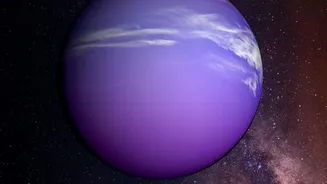
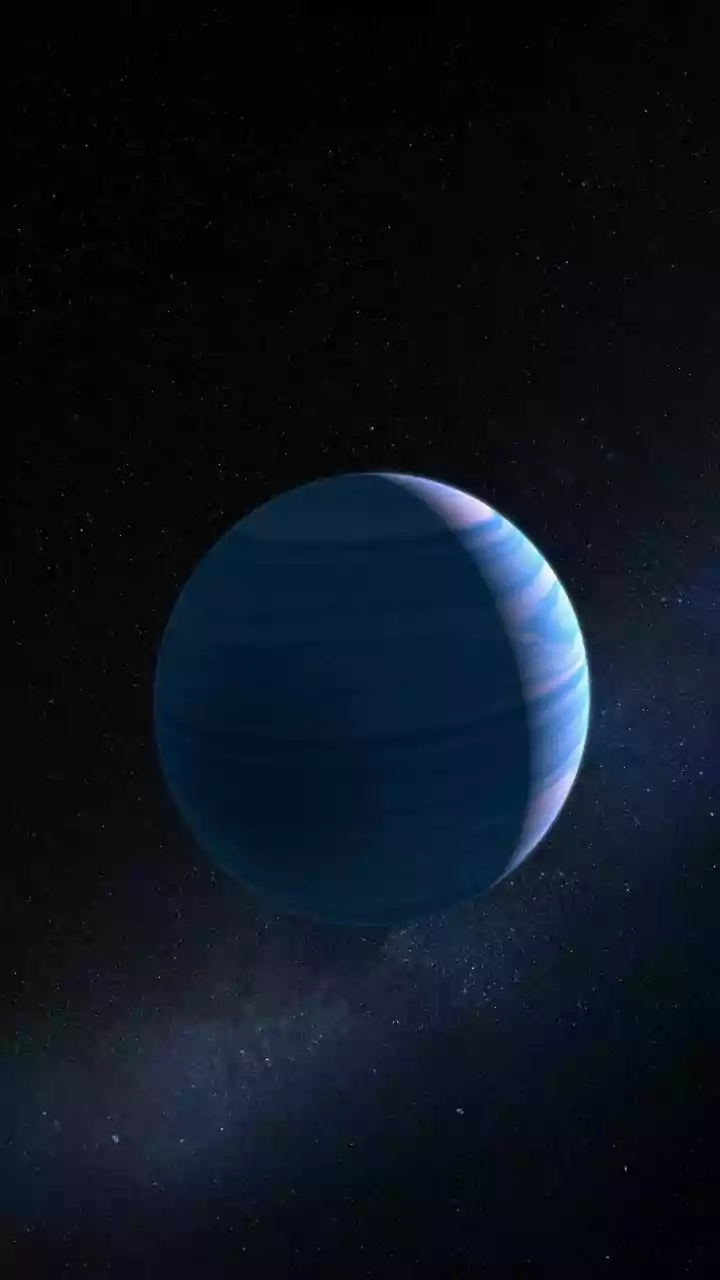
Even if the water vapor on a planet like GJ 486 b is confirmed to be from a planetary atmosphere, it doesn't mean we've found a lush, water-world. This particular planet is incredibly hot, with a surface temperature of around 430 degrees Celsius (800 F), making it far too hostile for liquid water. Another exoplanet, GJ 9827d, which is about twice Earth's diameter, also shows evidence of water vapor. Scientists believe it could be a 'mini-Neptune' with a hydrogen-rich atmosphere laced with water, or a hotter, larger version of Jupiter's moon Europa, which has a rocky core and a deep global ocean. If the latter is true, it would be an inhospitable, steamy world. While not habitable, the confirmation of a water-rich atmosphere on a rocky planet would still be a monumental discovery, proving that such worlds can form and exist.
The Search Continues
These findings are not the end of the story but a pivotal chapter. The ambiguity around the source of the water on GJ 486 b highlights the meticulous nature of scientific discovery. Each detection, even an uncertain one, refines our methods and deepens our understanding of planetary systems. Whether the water is from the planet or its star, the fact that JWST can make such a detailed observation is a huge leap forward. Scientists are now moving from simply detecting planets to characterizing them. The ultimate goal is to find a rocky planet in the 'habitable zone'—the right distance from its star for liquid water to exist on its surface—and analyze its atmosphere for the telltale biosignatures that could indicate the presence of life. The JWST's work is the first major step on that path.