








The Oxygen Problem on Mars
Before we can establish a foothold on Mars, we have to solve a massive logistical problem. Every kilogram of supplies launched from Earth is incredibly expensive, and two of the heaviest things a mission needs are oxygen for breathing and oxygen as a propellant
for the rocket trip home. In fact, getting a crew of astronauts off Mars and back toward Earth could require over 25 tons of liquid oxygen. Shipping that all the way from our planet is simply not a sustainable plan. The Martian atmosphere, which is 96% carbon dioxide, holds the key. If we can learn to reliably “live off the land” by converting that CO2 into oxygen—a process known as In-Situ Resource Utilization (ISRU)—we can fundamentally change the economics of space exploration.
The First Small Step: MOXIE
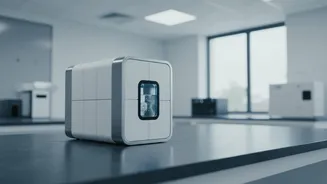
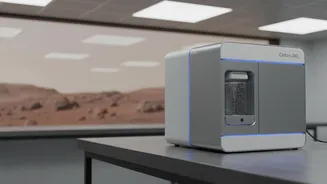
NASA has already proven that making oxygen on Mars is possible. A groundbreaking experiment aboard the Perseverance rover, called the Mars Oxygen In-Situ Resource Utilization Experiment (MOXIE), successfully produced oxygen on another world for the first time. The lunchbox-sized device worked by sucking in the thin Martian air, heating it to a scorching 800 degrees Celsius, and using a process called solid oxide electrolysis to split the CO2 molecules into oxygen and carbon monoxide. Over the course of 16 runs, MOXIE generated a total of 122 grams of oxygen, about what a small dog breathes in 10 hours. While a historic achievement, MOXIE's method is energy-intensive and produces oxygen slowly. It was a proof of concept, but to support a human mission, we need to scale up production by hundreds of times.
A New Challenger Appears: Plasma
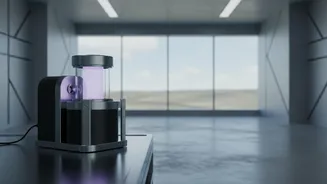
This is where a new wave of reactor technology comes in. Instead of just heat and pressure, researchers are turning to plasma. Teams at institutions like the University of Lisbon and the University of Antwerp have demonstrated that plasma reactors can split CO2 far more efficiently. The process works by using powerful electric fields to excite the Martian gas, essentially creating tiny lightning bolts inside a chamber. This electrifying process rips the CO2 molecules apart into their component parts, releasing oxygen. The beauty of this approach is that it works under the natural, low-pressure and low-temperature conditions of Mars, eliminating the need for the bulky and power-hungry compressors and heaters required by an electrolysis system like MOXIE.
Faster, Simpler, More Efficient
The early results from these plasma reactors are staggering. One research team showed that their reactor could produce oxygen about 30 times faster than MOXIE while using a similar amount of energy. A system that can generate 1.1 kilograms of oxygen per day—roughly what one astronaut needs—is a significant leap forward. This efficiency is the key to scaling up. A simpler, lighter system that doesn't need to fight against the Martian environment can be more easily scaled into a large, industrial-sized plant. Instead of a single small unit, a future mission could land a larger reactor capable of running continuously, stockpiling tons of oxygen in the 26-month window before the first human crew even arrives on the planet.
More Than Just Breathable Air
The benefits of plasma technology may extend beyond just making oxygen. The Martian atmosphere contains a small but useful amount of nitrogen. Researchers have shown that their plasma process can also be used to create nitrogen-based compounds, which are essential for making fertilizers. This opens the door to not just surviving on Mars, but building a self-sustaining agricultural system. Furthermore, some proposed designs are dual-purpose. A January 2026 paper outlined a CO2-breathing plasma thruster that could be used for maintaining a satellite's orbit in the upper Martian atmosphere while simultaneously producing oxygen as a byproduct. This kind of multi-functionality is crucial for making the most of every piece of equipment sent to Mars.
From Lab to Landing Pad
While promising, this technology is still in its early days. The successful experiments have so far been conducted in labs that simulate Martian conditions. The next step is to prove these systems can survive the rigors of spaceflight and operate reliably in the harsh, dusty, and unforgiving Martian environment. That development path is now being walked. In July 2026, a related technology called MARS-C, developed by the Southwest Research Institute, passed a critical NASA review for parabolic flight testing, which simulates Martian gravity. These tests are a crucial step in maturing hardware from a lab curiosity into a flight-ready system. Building a full-scale oxygen plant on another planet remains a monumental engineering challenge, but plasma technology presents the most promising path to overcoming it.