


A Day Longer Than a Year
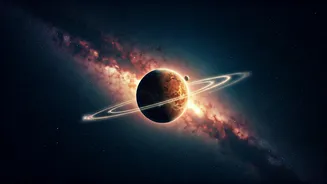
Let’s get the mind-bending numbers out of the way first. Venus takes about 225 Earth days to complete one orbit around the Sun. This is its year. However, it takes a staggering 243 Earth days to rotate just once on its axis. This is its day. So, yes,
a single Venusian day is longer than a Venusian year. If you could stand on its scorching surface, you would see the Sun set, wait for an entire year to pass, and still have to wait a few more weeks for the Sun to set again. To make things even stranger, Venus spins backwards compared to Earth and most other planets in our solar system. This is known as retrograde rotation. On Venus, the Sun rises in the west and sets in the east.
Earth’s Evil Twin
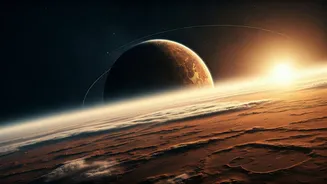
For a long time, Venus was called Earth’s “sister planet.” They are similar in size, mass, and density, and they are neighbours in the solar system. But the more we learn about Venus, the more it seems like our evil twin. Its surface temperature is a lead-melting 465° Celsius, hot enough to cook a pizza in seconds, and its atmospheric pressure is 92 times that of Earth’s at sea level—equivalent to being nearly a kilometre deep in the ocean. And then there's its bizarre rotation. While Earth has a brisk 24-hour day and a clear distinction between day and year, Venus presents a planetary puzzle that scientists have spent decades trying to solve. Its strange spin is not just a quirky fact; it’s a key clue to understanding its hellish environment and violent past.
Was It a Cosmic Collision?
For years, the leading theory for Venus’s strange spin was a dramatic one: a cataclysmic impact. The idea was that, billions of years ago, a planet-sized object smashed into Venus. This colossal collision would have been powerful enough to not just slow its rotation to a crawl but completely reverse its direction. This hypothesis is compelling because we believe a similar impact on Earth created our Moon and tilted our planet on its axis, giving us seasons. However, computer models simulating such an impact have struggled to produce a planet that looks like the Venus we see today. A crash big enough to reverse its spin would likely have obliterated the planet or resulted in a different orbital path or a companion moon, none of which we observe.
A Planet Ruled By Its Atmosphere
Today, a more compelling theory has taken centre stage, and it’s arguably even more fascinating. The secret to Venus’s slow, backward spin might be its atmosphere. The Venusian atmosphere is incredibly thick and heavy, a dense soup of carbon dioxide with clouds of sulphuric acid. It’s so thick that it behaves almost like a fluid, constantly churning and moving in a phenomenon called “super-rotation,” where the winds whip around the planet much faster than the planet itself spins. This creates powerful atmospheric tides—not of water, but of gas. Over billions of years, the friction and drag from this heavy, fast-moving atmosphere pressing down on the planet's surface could have acted like a powerful brake, slowing Venus’s rotation to its current crawl. This constant atmospheric torque is strong enough to counteract the Sun’s gravitational pull, which would otherwise have likely tidally locked Venus, forcing one side to permanently face the Sun.
The Delicate Gravitational Dance
The atmosphere isn't the only force at play. The Sun's immense gravity also pulls on Venus, creating tidal bulges in the planet's solid body, much like how the Moon creates ocean tides on Earth. This gravitational tug-of-war between the Sun and Venus’s own dense atmosphere has resulted in a strange equilibrium. The atmospheric tides are strong enough to slow the spin and prevent it from becoming tidally locked, while the Sun’s gravitational tides exert their own influence. The result is the lazy, 243-day retrograde rotation we see today. It’s a delicate balance of planetary-scale forces, a cosmic dance between gravity and weather that has played out over aeons.