





The Mystery of the Repeating Signal
Imagine receiving a message from a galaxy 500 million light-years away. Now imagine it arrives on a strict schedule: a flurry of signals for four days, followed by twelve days of silence, repeating every 16.35 days. This isn't science fiction; it’s a real
phenomenon known as a repeating Fast Radio Burst (FRB). FRBs are incredibly powerful, millisecond-long blasts of radio waves that can outshine their entire host galaxy. While hundreds have been detected since 2007, most are one-off events. It’s the repeating ones, like the famous FRB 180916, that have truly baffled astronomers. The universe is chaotic, and explosions don't typically follow a calendar. This bizarre periodicity has led scientists on a hunt for a 'cosmic alarm clock'—a natural mechanism that could trigger such regular bursts.
Suspects in the Cosmic Lineup
The leading suspect behind these mysterious bursts has long been a type of ultra-dense star called a magnetar. A magnetar is the collapsed core of a massive star, packing more mass than our sun into a sphere just a few kilometres wide. They possess magnetic fields thousands of times stronger than anything we can create on Earth. Scientists theorised that if a magnetar were wobbling like a spinning top (an effect called precession) or orbiting another star, its radio beam could sweep past Earth at regular intervals, creating a repeating signal. The discovery of an FRB from a magnetar within our own Milky Way galaxy gave strong support to this idea. However, for a long time, this was just a compelling theory without direct proof of a triggering mechanism.
A Breakthrough Observation
Recent scientific studies have provided crucial new evidence, narrowing down how these cosmic clocks might work. In one significant observation, an international team studied a magnetar, XTE J1810-197, that was seen to be wobbling. The systematic changes in its radio signals were exactly what you'd expect from precession, where the star's beam shifts its orientation relative to Earth. This was a huge step forward, directly observing a potential clockwork mechanism. However, the wobble surprisingly faded away after a few months, which challenges the idea that precession alone can explain long-term, stable periodicities seen in some FRBs. This suggests the universe may have more than one way to build an alarm clock.
It Takes Two to Tango
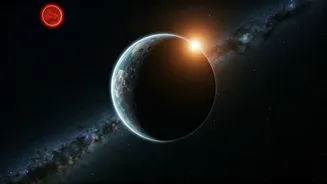
Another major breakthrough has come from studying different types of repeating signals called long-period radio transients (LPTs). Researchers traced one such signal, which pulses every 81 minutes, to a 'vampire star' system named ASKAP J1745-5051. In this binary system, a dense white dwarf star is actively pulling material from a nearby red dwarf companion. The powerful interaction of their magnetic fields as they orbit each other is believed to generate the steady, clock-like radio pulses. This finding demonstrates that binary systems, where two stars are locked in a gravitational dance, can act as reliable triggers for periodic cosmic signals, solving a long-standing puzzle for at least some of these repeating events.