



The Calorie Question Is Changing
For a long time, India's primary nutritional goal was ensuring citizens consumed enough calories. Spurred by economic growth and food security schemes, there has been progress. Data from recent national surveys indicates that average calorie intake in urban
areas is now slightly above the recommendation of 2,100 kcal/day, though it remains just below the 2,400 kcal/day guideline in rural areas. This has been driven by a significant dietary shift: a move away from a heavy reliance on cereals. As incomes grow, households are diversifying their food consumption, spending less on staple grains and more on other food groups. This marks a pivotal moment where the focus is slowly but surely moving from just filling the stomach to the quality of what's on the plate.
The Persistent Protein Puzzle
While India's protein consumption has seen gradual improvement, the picture is complicated. On average, daily protein intake meets the basic requirements. However, the quality and source of this protein are a major concern. A recent CEEW study based on the 2023-24 Household Consumption Expenditure Survey found that nearly half of the protein in Indian diets comes from cereals like rice and wheat. These are considered lower-quality proteins compared to sources like pulses, dairy, eggs, and meat. Consumption of pulses, a traditional and high-quality source of plant-based protein, contributes only 11% of protein intake, far below the recommended 19%. While the intake of animal-based proteins like milk, eggs, and meat is increasing, it still lags, especially among lower-income groups who may not be able to afford these options consistently.
Micronutrients: The Hidden Hunger
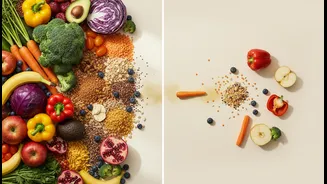
Beyond calories and protein lies the challenge of 'hidden hunger'—a deficiency in essential vitamins and minerals. An Indian diet, even one with adequate calories, can lack crucial micronutrients if it is dominated by cereals and lacks diversity. Deficiencies in iron, vitamin A, and zinc are widespread and have significant public health implications. Reports show that despite improvements, a large percentage of the population still does not consume enough fruits and vegetables. For example, over half of women were not consuming vitamin A-rich fruits as of 2021. This lack of dietary diversity means that even as calorie and protein goals are met, the body may be starved of the micronutrients essential for healthy development, immunity, and productivity. This imbalance is a critical frontier in India's nutritional journey.
A Tale of Two Indias: Urban vs. Rural Plates
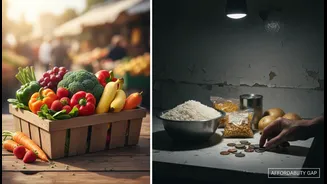
The transformation of India's food basket is not uniform across the country. Urban diets are diversifying more rapidly, with increased consumption of dairy, fruits, vegetables, and animal products. However, this shift also brings a higher intake of processed foods, fats, and sugars, creating new health challenges. In rural India, diets often remain more traditional and cereal-based. While this can mean less exposure to unhealthy processed foods, it also means that deficiencies in protein quality and micronutrients can be more pronounced. The gap between the richest and poorest households is stark; wealthier households consume far more diverse, high-quality proteins and nutrients than their poorer counterparts, who still struggle to afford a balanced plate.