





The Challenge of Mars
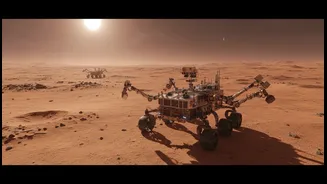
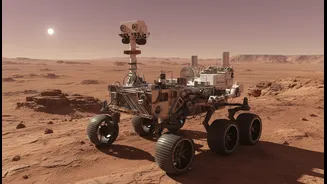
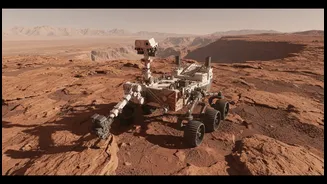
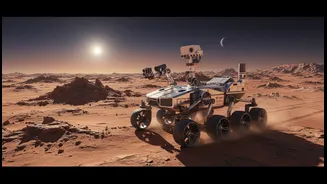
Exploring Mars has always been a battle against extreme conditions and the tyranny of distance. The Red Planet is a world of freezing temperatures, intense radiation, and a thin, carbon dioxide-rich atmosphere. For decades, NASA's rovers like Curiosity
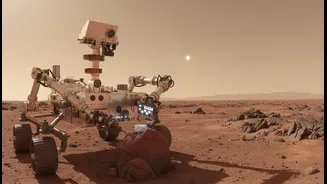
and Perseverance have acted as our remote-controlled hands and eyes, but they operate on a significant time delay. Commands can take up to 20 minutes to travel from Earth, meaning every move must be meticulously planned by human operators, limiting efficiency and the scope of exploration. This careful, deliberate process has yielded incredible discoveries, but to truly prepare for human missions, NASA needs robots that can do more, faster, and with less direct supervision.
A New Breed of Robotic Explorer
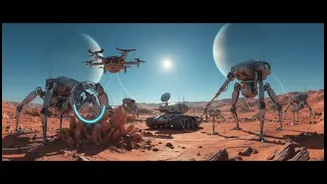
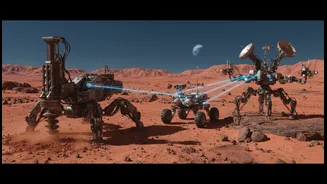
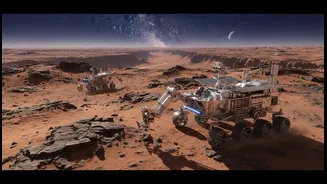
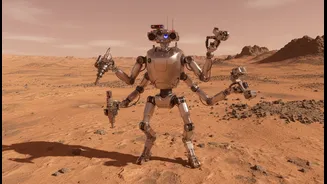
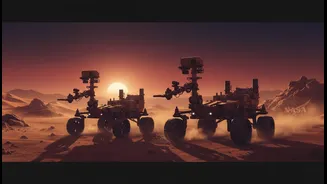
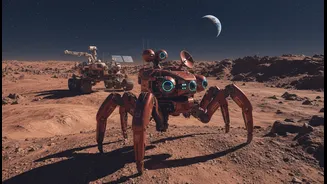
Enter the era of smarter machines. NASA's vision is to shift from single, heavily managed rovers to teams of autonomous robots that can collaborate. The goal is to develop systems that can make decisions on their own, navigate treacherous terrain, and even divide tasks to achieve complex scientific objectives without constant input from ground control. This leap in artificial intelligence and robotics is crucial for the agency's Moon to Mars strategy, which sees robots not just as explorers, but as essential partners in preparing for human arrival. These machines will be the advance scouts, construction crews, and scientific assistants for the first human outposts on another planet.
Teamwork on Another World: CADRE
A prime example of this new approach is the Cooperative Autonomous Distributed Robotic Exploration (CADRE) project. Currently slated for a technology demonstration on the Moon, CADRE features a trio of shoebox-sized rovers that will work together as a team. Communicating through a mesh network, they will autonomously map an area using ground-penetrating radar, taking simultaneous measurements from different locations to create a 3D map of the subsurface. This is something a single rover could never accomplish on its own. The technology is designed to be versatile and expandable, potentially becoming a standard off-the-shelf option for future missions on both the Moon and Mars. Its success would pave the way for multi-robot missions that can tackle riskier terrain and support astronaut activities.
AI Takes the Driver's Seat
The move toward autonomy is already being tested on Mars. In late 2025, the Perseverance rover completed its first-ever drives planned entirely by artificial intelligence. Using a type of generative AI, the rover analyzed orbital imagery and terrain data to plot its own safe course, something previously done by engineers on Earth. The successful tests covered hundreds of meters, demonstrating that AI can handle complex navigation while minimizing the workload on human operators. This capability will be game-changing, allowing future rovers to cover much greater distances and more efficiently scan for interesting scientific features, accelerating the pace of discovery.
Building the Future Human-Robot Partnership
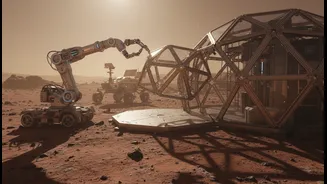
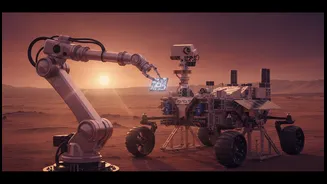
Ultimately, these smarter machines are foundational to NASA's long-term goal of sending humans to Mars. Autonomous robots will be essential for tasks like building habitats, prospecting for resources like water ice, and maintaining equipment before and during human missions. They can perform the dangerous and repetitive work, freeing up astronauts to focus on high-value scientific research and exploration. This human-robot partnership, where intelligent machines handle the groundwork, is seen as the key to establishing a sustainable presence on other worlds. The lessons learned from robotic systems on the Moon through the Artemis program will be directly applied to the far greater challenge of Mars.