







A Cosmic First Responder
Launched in November 2004, the Swift Observatory was designed for a very specific and fleeting purpose: to catch gamma-ray bursts (GRBs). These are the most powerful explosions in the universe since the Big Bang, often signaling the birth of a black hole
or the collision of dead stars. The challenge is that they are unpredictable and last from milliseconds to a few minutes. Swift was named for its ability to rapidly pivot its three telescopes—covering gamma-ray, X-ray, and optical/ultraviolet light—toward a new burst within seconds of detection. This rapid response allows it to capture crucial data about the burst's afterglow and alert a global network of ground-based observatories to join the study. Originally planned for a two-year mission, Swift has vastly outlived expectations, becoming a versatile tool for observing everything from comets to black holes.
The Gyroscope Problem
Like any machine running for over 20 years, Swift has faced wear and tear. A critical moment came in March 2024 when one of its gyroscopes, essential devices for pointing the spacecraft accurately, began to fail. The observatory uses a set of reaction wheels and gyros to orient itself in space. After a previous failure, the loss of another gyro meant the satellite could no longer operate as designed. The mission team had to place Swift into a temporary safe mode, suspending science operations. For a mission prized for its speed, being unable to point correctly was a critical failure. The team needed a fix, and fast. The solution was not a physical repair but a clever software patch that would teach the old satellite a new trick: how to operate with only two gyroscopes.
An Ingenious Software Fix
This is where the "space mechanic" analogy truly shines. Engineers on the ground couldn't physically replace the part, so they had to rewrite the rules of how the spacecraft moved. They developed and uploaded a software update that reconfigured Swift's attitude control system. This new system allows the spacecraft to use its remaining two gyroscopes in conjunction with its star trackers to maintain its pointing ability. The fix was successful, and by April 2024, Swift was back to conducting science. In fact, mission scientists noted that the new pointing strategy was so effective that the observatory's accuracy was even better than it was at launch. It was a remarkable demonstration of engineering creativity, extending the life of a vital scientific asset through pure ingenuity.
A New Challenge: Orbital Decay
While the gyroscope issue was solved with software, a more physical threat emerged. Increased solar activity has been heating and expanding Earth's upper atmosphere, creating more drag on low-orbiting satellites. This atmospheric drag has been pulling Swift downward, causing its orbit to decay much faster than anticipated. Without an intervention, the observatory was projected to make a fiery reentry into the atmosphere as early as late 2026. To combat this, operators suspended most of Swift's rapid slewing operations in early 2026, instead keeping it in a more aerodynamic orientation to minimize drag and buy precious time. This action has extended its orbital lifetime by several months, creating a window for an unprecedented rescue.
The Ultimate Repair Job
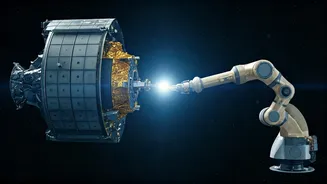
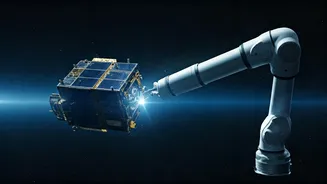
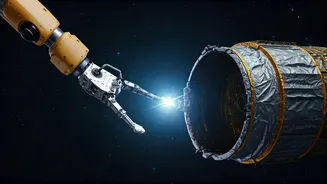
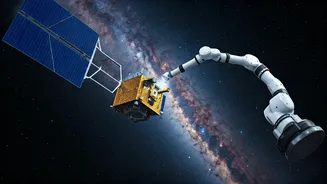
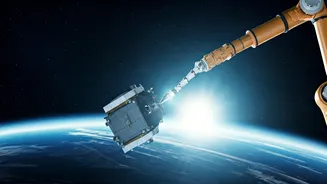
To save the observatory, NASA has embarked on a first-of-its-kind mission. The agency awarded a $30 million contract to a private company, Katalyst Space Technologies, to build and launch a robotic servicing spacecraft named LINK. This mission, scheduled for launch in July 2026, aims to send LINK to rendezvous with Swift, grab onto it with robotic arms, and physically push it into a higher, more stable orbit. The mission is high-risk, high-reward, as Swift was never designed to be serviced or docked with in space. After a few launch delays in early July, the team is working to get the rescue mission underway. If successful, it would not only save a valuable observatory but also pioneer a new era of commercial satellite servicing.