



A Telescope Unlike Any Other
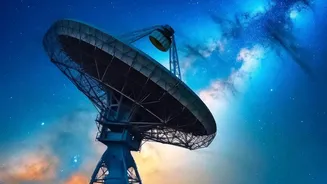
Located in British Columbia, Canada, the Canadian Hydrogen Intensity Mapping Experiment, or CHIME, doesn't look like a typical telescope. Instead of a large, steerable dish, it consists of four stationary, 100-metre-long U-shaped cylinders that resemble
snowboarding half-pipes. This unique design has no moving parts. It surveys more than half the sky every single day, not by pointing and tracking, but by letting the Earth's rotation sweep the cosmos over its field of view. This approach allows it to gather massive amounts of data with incredible efficiency, a key requirement for its ambitious mission to map the universe on an unprecedented scale. The telescope is designed to be a 'mapping machine', charting the sky's radio signals between 400 and 800 MHz.
The Whispers of Ancient Hydrogen
CHIME is hunting for a very specific and incredibly faint signal: radio waves emitted by neutral hydrogen, the most common element in the universe. This signal, known as the 21-centimetre line, was produced by hydrogen gas that filled the universe billions of years ago. As the universe has expanded over cosmic time, these ancient radio waves have been stretched to longer wavelengths before reaching Earth. By detecting these 'redshifted' signals, CHIME can effectively look back in time. The goal is to build a massive three-dimensional map showing how hydrogen gas was distributed when the universe was much younger. This method, called intensity mapping, measures the combined glow from vast regions of space rather than trying to spot individual, distant galaxies. It is a faster, more cost-effective way to chart the cosmos.
Finding a Needle in a Cosmic Haystack
Detecting this ancient hydrogen glow is exceptionally difficult. The cosmic signal is buried under radio 'noise' from our own Milky Way galaxy and other astrophysical sources that can be thousands of times brighter. Add to that interference from human-made sources like wireless networks, and the challenge becomes immense. For years, the technique was considered unproven, and initial efforts required cross-correlating CHIME's data with galaxy surveys from other telescopes to confirm a detection. However, as announced in late 2026, researchers have now achieved a major breakthrough: they have successfully detected the faint hydrogen signal using only CHIME's own data. This standalone detection proves the 'intensity mapping' technique works and solidifies CHIME's role as an independent cosmological tool.
A Ruler to Measure the Universe
So how does a map of ancient hydrogen help us understand dark energy? The answer lies in something called Baryon Acoustic Oscillations (BAOs). In the very early universe, pressure waves rippled through the hot, dense plasma, a bit like sound waves in the air. These waves left a faint, large-scale pattern in the distribution of matter, creating spherical shells where galaxies and hydrogen gas are slightly more likely to be found. The original size of these shells is known from our understanding of the early universe. This provides astronomers with a 'standard ruler' of a fixed cosmic length. By observing how large this ruler appears at different distances—and therefore at different times in cosmic history—scientists can precisely measure the expansion rate of the universe throughout its life.
Illuminating the 'Dark' in Dark Energy
Dark energy is the term given to the unknown force responsible for causing the universe's expansion to speed up, a phenomenon that has only been happening for the last few billion years. By using the BAO standard ruler to chart the expansion history with high precision, CHIME's data will allow scientists to test different theories about what dark energy is and how it behaves. This new method of mapping huge volumes of the universe faster than ever before offers a powerful, independent check on findings from other experiments, such as those that study distant supernovae. CHIME's ability to create a vast 3D map of a previously under-observed epoch provides a crucial new window into one of the most profound puzzles in modern physics.