



The Difference Between Handloom and Powerloom
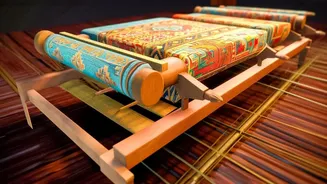
First, it's crucial to understand the fundamental difference. A handloom saree is woven entirely by a skilled artisan on a manually operated loom, a process that can take days, weeks, or even months. This slow, meticulous method results in a fabric with
a unique character. A powerloom, by contrast, is an electric or machine-operated loom that produces fabric at a much faster rate, focusing on uniformity and mass production. The problem isn't the existence of powerloom sarees, but when they are incorrectly sold as handloom, which cheats both the buyer and the weaver whose skill justifies the premium.
Look for Telling 'Imperfections'
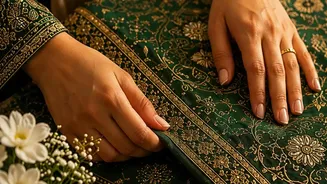
The beauty of a handloom saree is in its slight irregularities—these are not flaws, but hallmarks of human craftsmanship. A machine-made saree will look perfectly uniform, almost robotic in its consistency. In a handloom piece, look for minor variations in the weave or thread spacing. The selvedge (the finished edge running along the saree's length) is a key giveaway. On a handloom saree, it will be slightly uneven, whereas a powerloom saree has a perfectly straight, machine-finished edge.
Examine the Reverse Side of the Saree
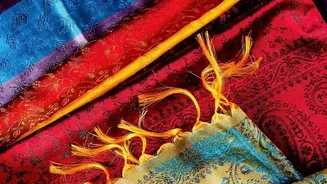
One of the most reliable checks is to simply flip the saree over. In a genuine handloom saree with woven motifs (like a Banarasi), the pattern's thread work, often called 'floats', will be visible on the back. The reverse side should be a near mirror of the front, showcasing the intricacy of the weave. A powerloom or printed imitation will often have a flat, perfectly clean back with no visible thread work, as the design is not woven into the fabric in the same way.
Seek Official Certifications
To protect both weavers and consumers, the Government of India has established certification marks. The 'Handloom Mark' guarantees that the product was woven on a handloom. For silk sarees, the 'Silk Mark', issued by the Silk Mark Organisation of India, certifies that the fabric is 100% pure, natural silk. A saree that carries both marks offers the highest level of assurance, confirming it is a genuine, hand-woven silk piece. Some weaves also have a Geographical Indication (GI) tag, which confirms its regional origin and traditional production method.
Assess the Quality of the Zari
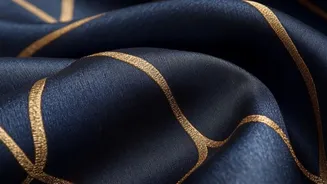
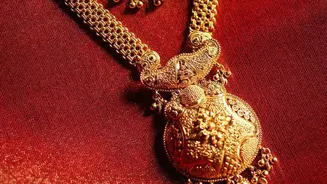
For sarees like Banarasi or Kanjivaram, the zari (metallic thread) is a major component of its value. Real zari is traditionally made with a silk thread core, wrapped in pure silver wire, and then electroplated with gold. This gives it a significant weight and a soft, subtle lustre, not an overly bright, artificial shine. Imitation zari is often made of copper wire or even plastic film, which is much lighter and can have a garish shine. Gently rubbing the zari can be a test; fake zari might reveal a white or red base, while real zari maintains its integrity.
Understand the Fabric's Feel and Drape
The feel, or 'hand-feel', of the fabric is another indicator. Handloom fabric has a distinct texture—it feels soft, breathable, and alive, with a beautiful drape that falls gracefully. Powerloom fabrics can feel stiff or overly uniform, almost plastic-like in their consistency. The base fabric's purity is also key. For example, a true Kanjivaram uses pure mulberry silk, which is known for its thickness and durability, while a Banarasi uses finer Katan silk. Be wary of sarees that feel too light for their intricate designs, as this might suggest the use of synthetic blends instead of pure silk.