







In the vast cosmic theater, some objects defy easy categorization. Meet brown dwarfs: too small to be stars, too large to be planets. Now, NASA’s SPHEREx telescope is providing our most detailed look yet at these enigmatic celestial bodies.
Meet SPHEREx, the Sky Mapper
Launched in
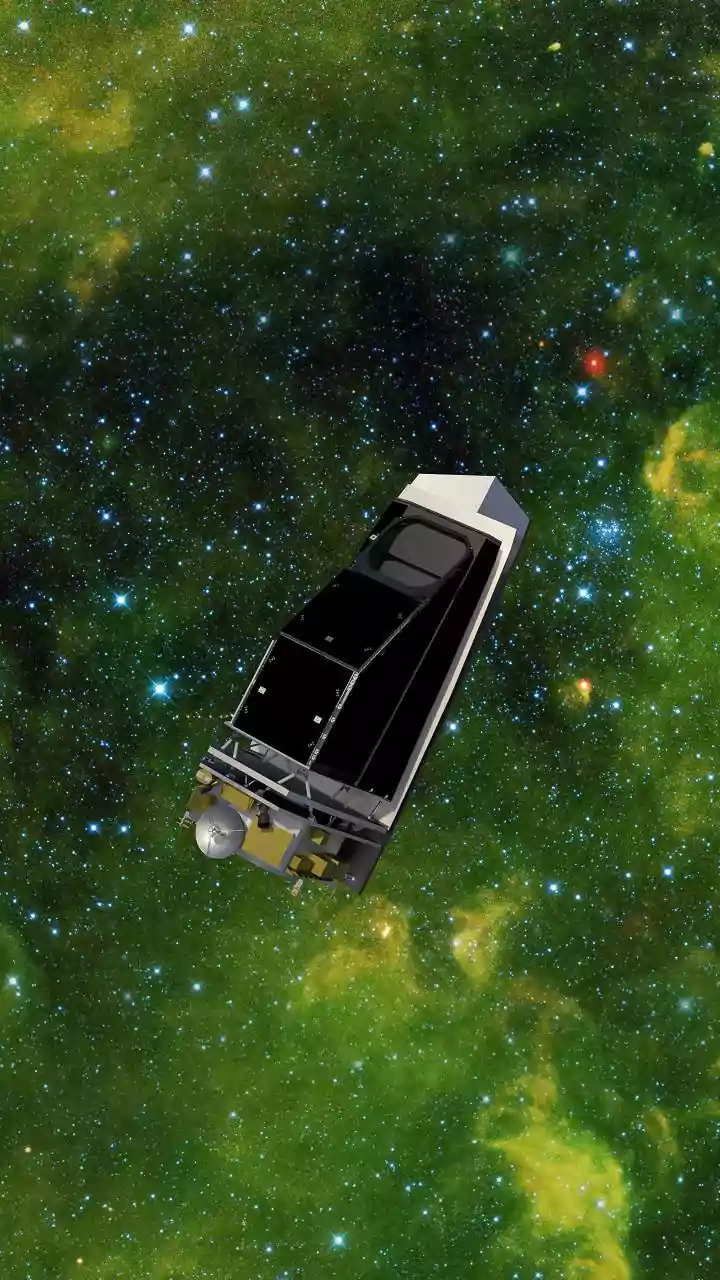
March 2025, NASA's SPHEREx (Spectro-Photometer for the History of the Universe, Epoch of Reionization, and Ices Explorer) is an orbiting observatory with a grand ambition: to map the entire sky. Unlike telescopes that focus on tiny patches of space, SPHEREx conducts an all-sky survey, creating a comprehensive map of the cosmos in 102 different colors of infrared light. This light is invisible to the human eye but carries a wealth of information about everything from the universe's origins to the building blocks of life. Managed by NASA's Jet Propulsion Laboratory, the mission scans the sky repeatedly, capturing data that will support countless astronomical investigations for years to come. While its primary goals are to study the early universe and the history of galaxies, it has proven to be an exceptionally powerful tool for other cosmic mysteries.
The Objects That Aren't Stars or Planets
Brown dwarfs are often called 'failed stars'. They form from collapsing clouds of gas and dust, just like stars do, but they never accumulate enough mass to ignite and sustain the hydrogen fusion that makes stars shine. Weighing in at between 13 and 75 times the mass of Jupiter, they are stuck in a celestial middle ground. After their initial formation, they simply cool and fade over billions of years, glowing faintly with leftover heat. This makes them incredibly dim and difficult to detect. Yet, they are fascinating to scientists because their atmospheres can serve as a bridge to understanding the atmospheres of giant exoplanets, which are often obscured by the glare of their parent stars.
Decoding Atmospheric Fingerprints
The key to the new study is spectroscopy—the science of breaking down light into its constituent colors or wavelengths. As light from a brown dwarf travels through its atmosphere, molecules like water, methane, and carbon monoxide absorb specific wavelengths, leaving behind a unique chemical 'fingerprint' or spectrum. By observing these objects in 102 distinct infrared colors, SPHEREx can create an incredibly detailed spectral map. This is a huge leap forward, as many of these infrared wavelengths are impossible to see from Earth because they are absorbed by water in our own atmosphere. The result is a clear view of the chemical soup that makes up these strange worlds.
A Surprising Chemical Diversity
In a recent study published in The Astrophysical Journal, scientists used SPHEREx to analyze 37 nearby brown dwarfs across a massive temperature range, from a star-like 2,200 degrees Celsius down to a frigid minus 20 degrees Celsius. The data revealed chemically rich atmospheres containing water, carbon monoxide, carbon dioxide, and methane. Scientists were surprised to find that no two brown dwarfs are exactly alike; even objects with the same temperature can have distinctly different spectra. As brown dwarfs cool, their atmospheric chemistry changes. The study captured some objects in a dynamic transition phase where cloudy layers thin out, giving way to atmospheres dominated by methane. These real-world observations are challenging existing theoretical models, which have struggled to accurately predict this complex atmospheric evolution.
From Dozens to Thousands
This initial study of 37 brown dwarfs is just the beginning. The SPHEREx mission is gathering data on thousands more of these objects. According to J. Davy Kirkpatrick, a scientist at Caltech, this will allow researchers to see 'what bounds the universe places on the variety of brown dwarfs'. By building such a large and detailed catalog, astronomers can refine their models of how substellar objects form and evolve. This knowledge doesn't just apply to failed stars; it provides crucial insights into the atmospheric physics of gas giant planets in our own solar system and beyond. The comprehensive data from SPHEREx will serve as a foundational resource for future, more targeted observations by instruments like the James Webb Space Telescope.