





Saturn at Its Brightest
October kicks off with a planetary highlight. On October 4, Saturn reaches opposition, the point where Earth passes directly between the ringed planet and the Sun. This alignment makes it one of the best times of the year to view Saturn, as it will be visible
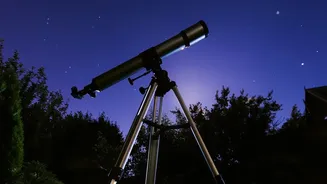
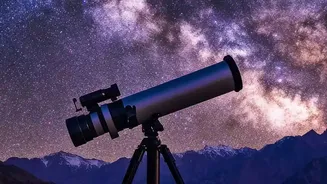
all night long, rising around sunset and setting around sunrise. Shining at a bright magnitude of 0.3, it will be easy to spot with the naked eye as a steady, golden point of light in the constellation Pisces. For observers in India, Saturn rises at approximately 6:11 p.m. on October 4, reaches its highest point just after midnight, and sets around 6:23 a.m. the next morning. While a telescope is needed to resolve its famous rings, the planet itself will be a commanding presence in the night sky throughout the month.
The Draconid Meteor Shower
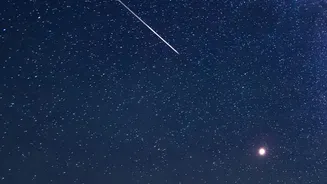
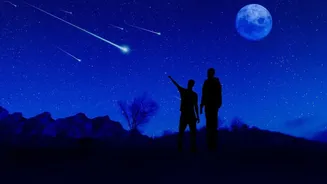
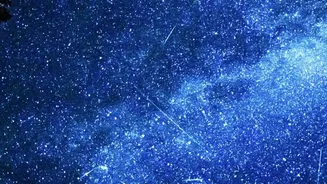
The first of two meteor showers this month is the Draconids, peaking on the night of October 8-9. What makes this shower unusual is that the best viewing time is in the early evening, just after darkness falls, rather than the typical post-midnight hours. The shower's radiant point, in the constellation Draco the Dragon, is highest in the sky at this time. In 2026, viewing conditions are excellent as the peak occurs just before the new moon, meaning no moonlight will wash out the display. While typically a modest shower producing around 5 to 10 meteors per hour, the Draconids are known for being unpredictable and have occasionally produced stunning outbursts. The meteors themselves are debris from comet 21P/Giacobini-Zinner and tend to be slow-moving, making them slightly easier to spot as they streak across the sky.
The Orionid Meteor Shower
The more famous October shower, the Orionids, will peak in the predawn hours of October 21-22. These meteors are fast, bright, and are actually tiny pieces of the celebrated Halley's Comet burning up in our atmosphere. Under ideal dark-sky conditions, you can expect to see between 15 and 20 meteors per hour. The shower's radiant is in the constellation Orion, but the meteors can appear anywhere in the sky. This year, a bright waxing gibbous moon will interfere with viewing for much of the night. However, the Moon sets around 3 a.m. local time, leaving a window of dark sky until dawn for the best chance to catch the show. So, set your alarm early, find a spot away from city lights, and look up.
The Full Hunter's Moon
October’s full moon, traditionally known as the Hunter's Moon, will reach its peak illumination on Monday, October 26. The name is tied to the season of hunting and preparing for the coming winter. While the precise moment of fullness occurs early in the morning, the best time to enjoy it is on the evening of Sunday, October 25, when it rises in the east around sunset. A full moon rising on the horizon can appear impressively large and take on a beautiful golden or orange hue. It will appear full and bright for the nights surrounding its peak as well, providing a stunning backdrop for evening strolls.
Other Planets to Spot
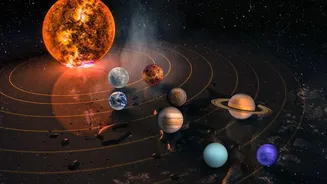
While Saturn is the star planet this month, it isn't the only one gracing the sky. Mars can be spotted in the early morning sky. Venus and Mercury will be very low on the horizon after sunset, making them challenging to observe for most, especially in the Northern Hemisphere. For those with a telescope, October is a great time to hunt for the great Andromeda Galaxy (M31). With the new moon on October 10 providing dark skies, it can even be spotted with the naked eye from a location far from city light pollution.