





The Horizon Spectacle
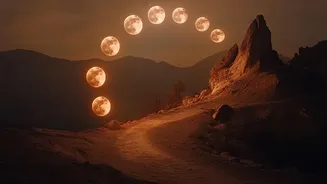
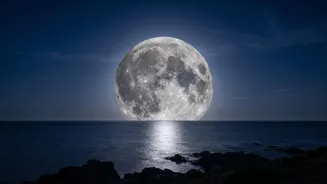
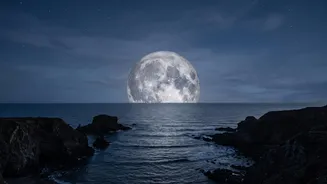
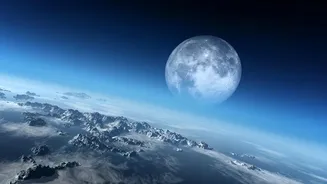
There are few celestial events as universally captivating as watching a full Moon rise. As it crests the horizon, appearing behind distant trees, buildings, or hills, it often looks enormous and painted in shades of orange or red. It’s a dramatic, almost
theatrical entrance. Then, as it climbs higher into the dark expanse of the night sky, it seems to shrink, eventually settling into its familiar, silvery-white self. For centuries, people have assumed that this must be a physical phenomenon—that the atmosphere is somehow magnifying the Moon like a lens. However, the truth is far more complex and involves a partnership between physics and psychology.
What Atmospheric Refraction Actually Does
Our planet is wrapped in a blanket of air that is densest near the surface and thins out with altitude. When light from a celestial object like the Moon enters our atmosphere, it has to travel through these layers of varying density. This journey causes the light rays to bend, a process called atmospheric refraction. It’s the same principle that makes a spoon appear bent in a glass of water. When the Moon is near the horizon, its light travels through a much thicker slice of the atmosphere than when it's directly overhead. This increased travel through dense air has two very real, observable effects on the Moon's appearance, neither of which is enlargement.
Altering Colour and Shape
The first major effect of refraction is a change in colour. As moonlight passes through the thickest part of the atmosphere, shorter wavelengths of light—the blues and violets—are scattered away by air molecules. This allows the longer wavelengths—the reds, oranges, and yellows—to pass through to our eyes, giving the horizon Moon its characteristic warm glow.The second effect is a distortion of shape. The amount of refraction is greater closer to the horizon. This means the light from the bottom edge of the Moon is bent more upwards than the light from the top edge. The result is that the Moon appears slightly flattened or squashed, as if someone is pressing down on it. So, far from making it look bigger, atmospheric refraction actually makes the Moon look slightly shorter vertically.
Debunking the Size Myth
The idea that the atmosphere enlarges the horizon Moon is a persistent myth, but one that is easily disproven. If you take a photograph of the Moon near the horizon and another later that night when it’s high in the sky, using the exact same camera settings, you will find that the Moon is the same size in both pictures. In fact, the Moon is actually about 1.5% farther away from an observer when it is on the horizon compared to when it is overhead, which technically makes its angular size slightly smaller. The dramatic size difference we perceive is not a physical reality but a powerful optical illusion generated entirely within our minds.
Your Brain Is the Real Magician
This phenomenon is known as the 'Moon illusion,' and it has puzzled thinkers since ancient times. While scientists still debate the precise mechanisms, the leading explanation is a psychological one tied to how our brains perceive distance and size. It often involves what is known as the Ponzo illusion. This classic optical trick shows that two identical lines can appear to be different sizes depending on the background visual cues. For example, if two identical lines are placed on a drawing of converging railway tracks, the line that appears 'farther' down the tracks will be perceived as being larger.
The Sky as a Reference Frame
When the Moon is on the horizon, our brains have plenty of reference points—trees, buildings, and mountains. We know these objects are far away, and our brain interprets the Moon, which appears behind them, as being even farther. In the empty expanse of the overhead sky, there are no such reference points. Our brain perceives the sky above as being closer than the sky at the horizon. So, when presented with two objects of the same angular size (the horizon Moon and the overhead Moon), our brain follows a simple but flawed rule: if that object on the horizon is so far away, it must be enormous. It's a mental scaling trick, not a physical one.