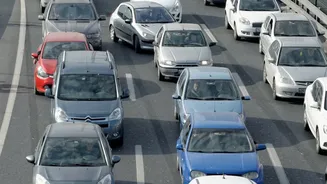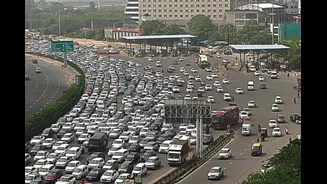



As winter approaches, Delhi is bracing for its annual battle with air pollution. From November 1, a new set of restrictions on vehicles will be strictly enforced at the capital's borders, carrying hefty fines for violators.
Understanding the Winter Action Plan
Every year, as temperatures
drop, a combination of factors including stubble burning, festive fireworks, and meteorological conditions trap pollutants in the air, causing Delhi's Air Quality Index (AQI) to spike to hazardous levels. To combat this, the Commission for Air Quality Management (CAQM) activates a Graded Response Action Plan (GRAP). Separate from GRAP, the Delhi government has its own Winter Action Plan, which includes proactive measures. This year, a key part of that plan is a pre-emptive ban on certain vehicles entering Delhi, which will be in effect from November 1, 2026, to January 31, 2027, regardless of the active GRAP stage. The goal is to cut down on vehicular emissions, a major contributor to the city's winter smog.
Which Vehicles Are Banned?
The upcoming restrictions target older, more polluting vehicles. Specifically, the ban impacts two main categories. The first is a blanket ban on all vehicles registered outside of Delhi that do not meet the Bharat Stage VI (BS-VI) emission norms. This primarily affects BS-III and BS-IV compliant cars and commercial vehicles. The second category relates to GRAP Stages III and IV. If these stages are invoked due to 'Severe' or 'Severe+' air quality, a ban on BS-III petrol and BS-IV diesel light motor vehicles (four-wheelers) will apply across Delhi and key NCR districts like Gurugram, Faridabad, Ghaziabad, Gautam Buddh Nagar, and Sonipat. Vehicles running on CNG, electric power, and all BS-VI compliant vehicles are exempt from these specific restrictions.
The Heavy Cost of Non-Compliance
Commuters and drivers are advised to take these rules seriously, as the financial penalties for violations are substantial. Anyone caught driving a vehicle in contravention of the GRAP Stage III or IV ban (specifically BS-III petrol and BS-IV diesel cars) faces a hefty fine of ₹20,000. This penalty is enforced under Section 194(1) of the Motor Vehicles Act. In addition to the fine, authorities have the power to impound the vehicle. Separately, the 'No PUC, No Fuel' rule is also in effect, meaning vehicles without a valid Pollution Under Control Certificate can be denied fuel and fined up to ₹10,000.
How Will the Ban Be Enforced?
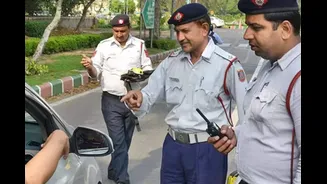
Enforcement will be a mix of technology and onground personnel. The Delhi government is deploying around 250 to 300 enforcement personnel from the Transport Department and Delhi Police at all major entry points to the city. These teams will be stationed at 13 major toll plazas, including those at DND, Rajokri, Singhu border, and Ghazipur, to conduct physical checks. To supplement these efforts, a network of AIpowered Automatic Number Plate Recognition (ANPR) cameras will be used at border checkpoints. These cameras will automatically scan licence plates, identify noncompliant vehicles registered outside Delhi, and flag them to the enforcement teams.
Are There Any Exemptions?
While the rules are strict, there are a few exceptions. The ban on nonBSVI vehicles does not apply to vehicles running on CNG or electricity. Additionally, vehicles providing essential and emergency services, such as ambulances, fire tenders, and those involved in government enforcement duties, are permitted to operate. However, a significant change this year is the removal of exemptions for older goods vehicles carrying essential commodities under GRAP Stages III and IV. This means many commercial trucks that were previously allowed will now be restricted based on their emission standards.
What Commuters Should Do
If you commute to Delhi from an NCR city, the first step is to check your vehicle's Registration Certificate (RC) or use the online Parivahan portal to confirm its emission norm. If you own a nonBSVI vehicle registered outside Delhi, you will need to find alternative transport, such as the Metro or compliant bus services, between November 1 and January 31. For those with Delhiregistered BSIII petrol or BSIV diesel cars, it is crucial to monitor the daily AQI and GRAP stage announcements. If Stage III is invoked, your vehicle will be barred from the roads. All vehicle owners must also ensure their PUC certificate is valid to avoid fines and be able to refuel.