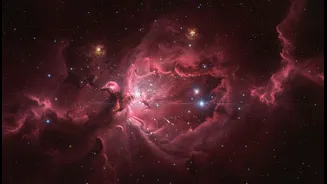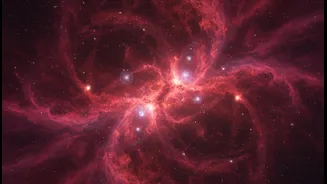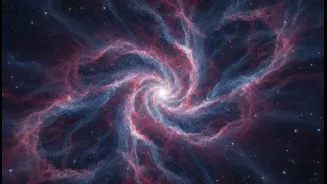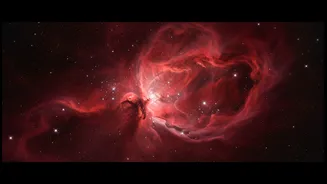




Meet the Emission Nebula
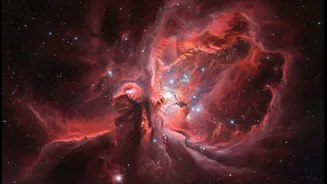
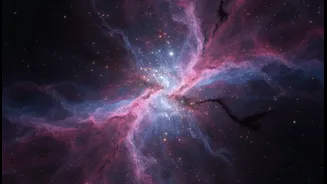
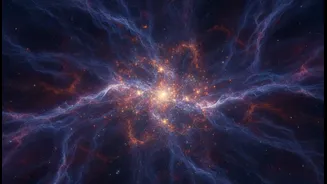
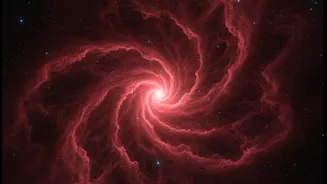
That beautiful red cloud you see in pictures from the Hubble or James Webb telescopes is most likely an emission nebula. The word 'nebula' is Latin for cloud, and these are enormous interstellar clouds of gas and dust. They are gigantic, often spanning
dozens or even hundreds of light-years across. Think of them not as smoke, but as incredibly vast and spread-out regions where the building blocks of the universe gather. While they look thick and bright, the gas is actually extremely thin, far less dense than the air we breathe. These nebulae are often called 'star nurseries' because they are the very places where new stars are born.
The Secret of the Colour Red
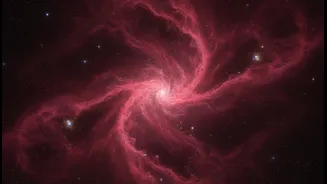
So, why red? The answer lies in the most common element in the universe: hydrogen. Emission nebulae are mostly made of hydrogen gas. Inside or nearby these clouds are young, massive, and incredibly hot stars. These stars blast out a huge amount of high-energy ultraviolet (UV) radiation. This intense radiation is powerful enough to energize the hydrogen atoms, stripping away their electrons in a process called ionization. But the atoms don't stay that way for long. The electrons eventually recombine with the hydrogen nuclei, and as they do, they release their extra energy in the form of light. Specifically, they emit light at a very particular wavelength in the red part of the spectrum known as Hydrogen-alpha, or H-alpha. This specific red glow is so dominant that it becomes the signature colour of the entire nebula.
More Than Just a Pretty Colour
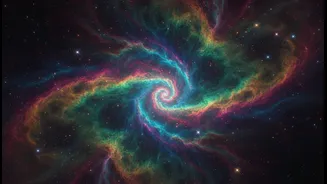
While red is the most common colour, you might also see hints of blue or green in these nebulae. These other colours are produced by other elements like oxygen or helium, which get energized in the same way as hydrogen but emit light at different wavelengths. The exact colours tell astronomers a lot about the nebula's chemical composition, temperature, and density. The red H-alpha light is a direct signpost that active star formation is happening. The very stars causing the cloud to glow were likely born from that same cloud millions of years ago. These stellar nurseries are a crucial part of the cosmic life cycle. Stars are born from the gas, live their lives, and when they die, they can scatter new elements back into space, enriching the next generation of nebulae and stars.
Cosmic Nurseries in Action
Famous examples of these red emission nebulae include the Orion Nebula and the Lagoon Nebula. The Orion Nebula is one of the brightest and can even be seen with the naked eye from a dark location. These regions are chaotic and beautiful, with the powerful winds and radiation from the young stars carving out intricate shapes, pillars, and cavities in the surrounding gas. Structures like the famous 'Pillars of Creation' in the Eagle Nebula are sculpted by this very process. By studying these red clouds, astronomers can get a direct look at the processes of how stars and even planetary systems begin to form, helping us piece together the story of our own origins in the cosmos.