



The Junkyard Above Our Heads
Low Earth Orbit (LEO), the orbital band from about 160 to 2,000 kilometres up, is essential for much of our daily lives. It is home to thousands of active satellites that provide everything from GPS navigation and weather forecasting to television broadcasts
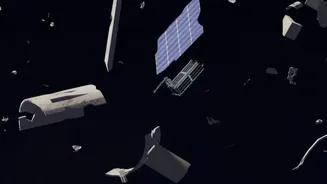
and internet connectivity. But LEO is also home to a vast and growing cloud of space debris. This includes defunct satellites, spent rocket stages, and millions of smaller fragments from past collisions and explosions. There are tens ofthousands of trackable objects, each moving at speeds of over 28,000 kilometres per hour. At that velocity, even a tiny paint fleck can cause catastrophic damage to an operational satellite. Scientists have long warned of a scenario called the Kessler Syndrome, where collisions create more debris, leading to a chain reaction that could render entire orbits unusable for generations. This would cripple the global infrastructure we depend on.
Solution 1: Nets and Magnets
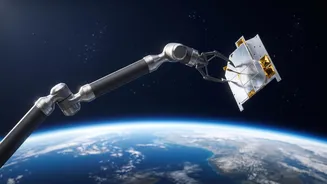
One of the most promising approaches to capturing large, tumbling pieces of debris involves nets and magnets. While the headline combines them, they are often distinct technologies. Space nets function much like their terrestrial counterparts. A 'chaser' spacecraft fires a large net to envelop an uncooperative target, like a dead satellite. Once ensnared, the chaser can then tow the object into a lower orbit where it will burn up in the Earth's atmosphere. This method is versatile because it can work on debris of various shapes and sizes. The European Space Agency (ESA) and the RemoveDEBRIS mission have successfully tested net capture in orbit. Magnetic capture, on the other hand, offers a more elegant, contactless solution. Some concepts involve launching satellites with a pre-installed magnetic docking plate, which a cleanup craft can easily latch onto at the satellite's end of life. A more advanced idea involves using powerful electromagnets to create a magnetic field that induces electrical currents in conductive debris, effectively turning the junk into a temporary electromagnet that can be maneuvered without physical contact. This avoids the risk of creating more fragments during a physical capture.
Solution 2: Harpoons and Lasers
For a more direct approach, engineers are turning to harpoons and lasers. A space harpoon is a projectile fired from a chaser vehicle to pierce the skin of a target like a spent rocket body. Attached by a strong tether, the harpoon allows the chaser to get a firm grip on the debris, control its spin, and pull it down to burn up safely. Like nets, harpoons have also been successfully demonstrated in space by missions like RemoveDEBRIS, proving the concept is sound. Lasers offer a futuristic, contactless alternative. The goal is not to vaporize the debris but to gently nudge it. By focusing a powerful laser beam on an object's surface, a tiny amount of material is vaporized in a process called laser ablation. This creates a small plume of plasma that acts like a miniature rocket thruster, subtly altering the debris's orbit over time. Repeated nudges can push an object onto a trajectory that leads to its eventual atmospheric re-entry. This technique is seen as particularly useful for dealing with smaller, more numerous pieces of debris that are impractical to capture with nets or harpoons.
Are They Truly Practical?
The technology behind these solutions is rapidly maturing from theory to reality. Successful in-orbit demonstrations have proven that nets and harpoons work. Several private companies, like the Swiss startup ClearSpace and the Japanese firm Astroscale, are now developing commercial services for active debris removal, with missions planned for the coming years. However, significant hurdles remain. Each removal mission is incredibly expensive, costing tens or even hundreds of millions of dollars. There are also complex legal questions about liability—who is responsible for removing a defunct satellite, and who is at fault if a removal attempt goes wrong? Despite these challenges, the consensus is growing that doing nothing is not an option. The cost of inaction, potentially losing access to vital orbits, is far greater.
India's Stake in a Cleaner Orbit
India, as a major spacefaring nation with significant assets in orbit, has a vested interest in a sustainable space environment. The Indian Space Research Organisation (ISRO) is actively working on the problem. ISRO's 'Debris Free Space Mission' initiative aims for all Indian space missions to be debris-neutral by 2030. The organisation is not only focusing on preventing the creation of new junk but is also developing its own Active Debris Removal (ADR) capabilities and has started on-orbit demonstrations of precursor technologies. These efforts are crucial to protect India's own communication, remote sensing, and navigation satellites from the growing threat, ensuring the nation can continue to leverage space for its development.