







The Ocean's Critical Role
Covering more than 70% of our planet, the ocean acts as a giant thermostat. It soaks up enormous amounts of solar energy and carbon dioxide, distributing heat around the globe through massive currents. This process regulates temperatures and weather patterns,
including those that affect the Indian monsoon. Without the ocean's immense capacity to absorb CO2 and heat, our atmosphere would be significantly warmer. The deep sea, in particular, is a long-term storage vault for this heat and carbon. Understanding what happens here is not just an academic exercise; it's fundamental to predicting sea-level rise, ocean acidification, and the future intensity of storms that threaten coastal communities in India and worldwide.
Reading History from the Seafloor
One of the most powerful tools for looking into the past is the sediment core. For millions of years, tiny particles—dust, volcanic ash, and the shells of dead microscopic organisms—have been settling on the ocean floor, creating a layered timeline of Earth's history. Scientists use massive drilling ships to extract long tubes of this mud. By analysing the chemical composition of tiny fossils called foraminifera within these layers, they can reconstruct past ocean temperatures. Layers of dust can indicate ancient droughts or wind patterns, providing invaluable context for the climate changes we are witnessing today. These cores have been instrumental in confirming long-term climate cycles and understanding how Earth's systems responded to past shifts in carbon dioxide.
An Army of Robotic Explorers
To get a real-time pulse of the ocean, scientists rely on a global fleet of nearly 4,000 robotic floats known as the Argo program. These autonomous devices drift with the currents far below the surface. Every 10 days, they dive as deep as 2,000 metres, then slowly ascend, measuring temperature and salinity as they go. Once they reach the surface, they transmit their precious data to satellites before diving again. This revolutionary system provides a constant stream of information from vast areas of the ocean that ships rarely visit, especially in treacherous weather. The data from Argo floats is crucial for the Intergovernmental Panel on Climate Change (IPCC) reports and has fundamentally changed our ability to track how much heat the ocean is storing.
Permanent Windows into the Abyss
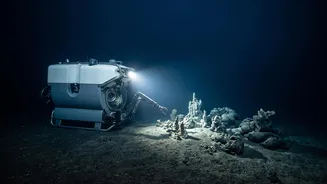
While Argo floats are mobile, fixed observatories provide a different, equally vital perspective. These deep-sea stations are anchored to the seafloor, sometimes connected by kilometres of cable, and are packed with sensors. The Ocean Observatories Initiative (OOI), for example, includes stations that supply a continuous, long-running stream of data on everything from temperature and salinity to ocean chemistry and currents. These moored buoys and cabled arrays can measure changes happening over seconds, seasons, and decades in the exact same spot. This high-resolution data is essential for understanding the effects of marine heatwaves, monitoring ocean acidification, and tracking conditions that affect fisheries and coastal flooding. They are our permanent eyes in the deep, capturing events that drifting floats might miss.
From Data Points to Global Models
Collecting the data is only half the battle. The true power of this research comes when the information from sediment cores, thousands of Argo floats, and fixed observatories is combined and fed into sophisticated climate models. Supercomputers crunch these vast datasets to improve our understanding of complex ocean processes. This allows scientists to refine predictions about how quickly sea levels will rise, how ocean currents might shift, and how marine ecosystems will respond to ongoing change. The more accurate and comprehensive the deep-sea data, the more reliable our climate forecasts become. This knowledge empowers policymakers and communities to prepare for the challenges ahead and develop strategies to mitigate the impacts of a changing climate.