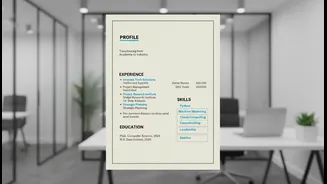









Mindset Shift: It’s a Resume, Not a CV
The first step is understanding the fundamental difference between an academic curriculum vitae (CV) and an industry resume. An academic CV is a comprehensive, multi-page document detailing your entire scholarly journey: every publication, conference,
and grant. In contrast, an industry resume is a concise, targeted marketing document, typically one to two pages long, designed to show a recruiter you are the right fit for a specific role. Recruiters often spend just seconds scanning a resume, so clarity and brevity are essential.
Start with a Professional Summary
Replace the lengthy objective statement common in academia with a powerful professional summary. This is a short, three-to-five sentence paragraph at the top of your resume. It should immediately convey your expertise, key skills, and career goals in a way that aligns with the job description. Instead of highlighting a niche research topic, focus on your ability to manage projects, analyze complex data, or communicate with diverse stakeholders.
Translate Experience into Achievements
Industry hiring managers care more about results than responsibilities. Your resume must translate your academic duties into quantifiable achievements. Instead of just listing tasks, use the X-Y-Z formula: Accomplished [X] as measured by [Y] by doing [Z]. For example, “Taught an undergraduate course” becomes “Instructed and mentored 50+ students, improving average final grades by 15% through redesigned course materials.” This reframes your experience in the results-driven language of business.
Reframe Your Research and Publications
An exhaustive list of publications and presentations holds little value for a non-academic audience. Instead of a “Publications” section, consider creating a “Selected Projects” section. Frame your PhD or postdoctoral research as a multi-year project you managed. Highlight aspects like budget management (from grant writing), meeting deadlines, and presenting findings to senior stakeholders (like your thesis committee). This showcases project management skills, not just scholarly output. A long publication list can be removed to save space for more relevant information.
Showcase Your Transferable Skills
Academia equips you with a vast array of valuable skills, but you need to make them explicit. Create a dedicated “Skills” section that highlights both technical abilities (like Python, R, or lab equipment) and transferable soft skills. Important skills to list include project management, data analysis, critical thinking, public speaking, and leadership. Analyse job descriptions in your target industry to identify keywords and ensure your resume includes them, which helps with automated Applicant Tracking Systems (ATS).
Simplify and Remove Academic Jargon
Your resume needs to be understood by HR generalists, not just experts in your field. Avoid all specialised academic jargon. A good test is to have someone outside your field read it; if they have to ask what a word means, replace it with a simpler term. For example, instead of describing a complex methodology, explain the outcome in plain language. The goal is to make your value immediately clear without requiring the reader to decipher complex terminology.