






A Historic Launch from California
In the early hours of July 7, a SpaceX Falcon 9 rocket lifted off from Vandenberg Space Force Base in California. This was the company's 17th dedicated rideshare mission, a program that acts like a space-bound carpool by packing dozens of small satellites
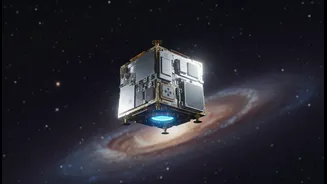
onto a single rocket. This flight, named Transporter-17, was carrying an impressive 81 different payloads from a variety of commercial, government, and academic customers. About 50 minutes after liftoff, the rocket's upper stage began the carefully choreographed process of deploying its cargo into orbit. While the sheer number of satellites is noteworthy, one particular payload stood out: a small satellite named BOHR, the first of its kind.
What 'Nuclear-Powered' Really Means Here
The term “nuclear-powered” often brings to mind large, complex reactors, but the technology aboard the BOHR satellite is fundamentally different and much safer. The satellite, whose name stands for Betavoltaic Orbital High-Reliability, is testing a new type of power source from a Florida-based company called City Labs. It uses a proprietary technology called NanoTritium. This system harnesses the natural radioactive decay of tritium, a form of hydrogen. As tritium decays, it releases beta particles (electrons), which are then converted directly into electricity by a semiconductor. This is different from the Radioisotope Thermoelectric Generators (RTGs) used on famous NASA missions like Voyager and the Mars rovers, which convert the heat from decaying plutonium into electricity. The BOHR system is a demonstration, with the main satellite still using conventional solar panels for its primary operations.
A Pathfinder for Future Exploration
The goal of the BOHR mission is to prove that this betavoltaic technology can provide a continuous, long-lasting source of power in space, independent of sunlight. This is a critical challenge for future space exploration. Solar power is effective for satellites in Earth orbit, but it becomes impractical for missions venturing into deep space or to locations that don't receive consistent sunlight. City Labs and other proponents believe this technology could one day power missions in the permanently shadowed craters of the Moon, which are of great interest for their potential water-ice deposits, or on long journeys to the outer solar system. According to City Labs CEO Peter Cabauy, the launch marks a “historic step for commercial nuclear power in space,” demonstrating that safe and compact nuclear systems are ready for deployment.
The Rideshare Revolution
The BOHR satellite was just one of 81 payloads on the flight, highlighting the importance of SpaceX's rideshare program. These missions have dramatically lowered the cost of accessing space, allowing startups, universities, and smaller nations to launch their own technology. The Transporter-17 manifest was a cross-section of the modern space industry, including Earth-observation satellites for South Korea, military technology demonstrators, and even 3D printers. By packing a rocket to capacity, SpaceX can offer a flight to orbit for a fraction of the cost of a dedicated launch. This model has become a vital pipeline for innovation, with SpaceX having launched over 1,800 payloads through its rideshare programs to date.