
The Martian Air Problem
For humans to survive on Mars, they need oxygen. A lot of it. The challenge is that the Martian atmosphere is fundamentally hostile to human life. It is incredibly thin, about 100 times less dense than Earth's, and consists of 96% carbon dioxide. Oxygen
makes up a mere 0.13%. Transporting the vast quantities of oxygen needed for life support and, even more critically, for rocket propellant to return home would be astronomically expensive and logistically nightmarish. A crew of four to six astronauts would require a massive amount of oxygen for an 18-month stay, but the rocket needed for their ascent off Mars would demand ten times that amount. The only viable long-term solution is to ‘live off the land,’ a concept known in the space industry as In-Situ Resource Utilization (ISRU). This means creating what you need from the resources available on the planet itself.
A Toaster-Sized Tree on Mars
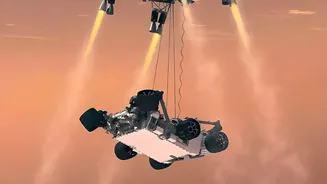
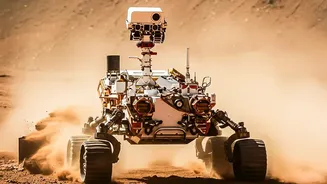
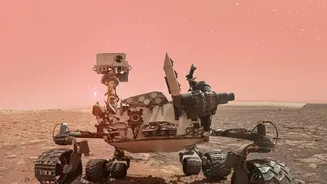
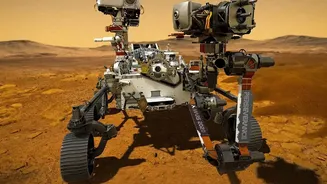
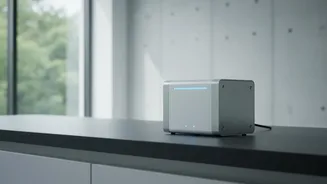
The first major breakthrough in this field came from a lunchbox-sized instrument aboard NASA's Perseverance rover. Called MOXIE (Mars Oxygen In-Situ Resource Utilization Experiment), this device was designed to do something extraordinary: breathe in the toxic Martian atmosphere and exhale pure oxygen. MOXIE works through a process called solid oxide electrolysis. It pulls in Martian air, filters out the dust, and heats the carbon dioxide to around 800 degrees Celsius. An electric current is then applied, splitting the CO2 molecules into carbon monoxide (which is vented as waste) and oxygen ions. These ions recombine to form breathable, molecular oxygen (O2). Over its mission, which concluded in 2023, MOXIE successfully ran 16 times under various Martian conditions, proving the fundamental chemistry works reliably on another planet.
From Grams to Tons: The 'At Scale' Challenge
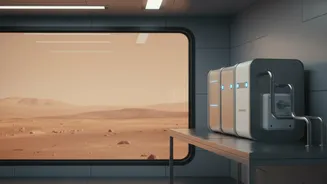
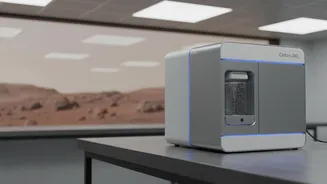
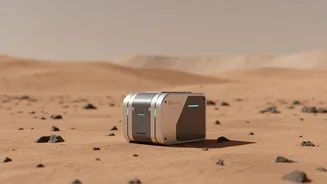
While MOXIE was a spectacular success, it was a technology demonstration, not a full-scale production plant. At its peak, it produced about 12 grams of oxygen per hour—roughly the rate of a small tree on Earth and enough to keep an astronaut breathing for about 20 minutes. In total, it generated 122 grams of oxygen over its lifetime. To support a human mission, future systems need to be scaled up by several hundred times. Scientists envision a much larger, more powerful version of MOXIE, perhaps the size of a small freezer, that could run continuously for over a year before astronauts even arrive. This system would need to generate oxygen at a rate of several kilograms per hour, not grams, to fill large storage tanks with enough breathable air and liquid oxygen to fuel a Mars ascent vehicle for the return journey.
The Next Generation of Oxygen Tech
MOXIE's success has kicked open the door for a new generation of more advanced and efficient technologies. Researchers are now exploring multiple pathways to scale up production. One promising avenue involves improving the solid oxide electrolysis process itself, aiming for systems with over 90% efficiency, a huge leap from MOXIE's 10% efficiency. Another innovative approach, developed by engineers at Washington University, focuses not on the atmosphere, but on the salty water, or brine, believed to exist beneath the Martian surface. Their brine electrolyzer was shown in simulated Martian conditions to produce 25 times more oxygen than MOXIE for the same amount of power. As a major bonus, this method also produces hydrogen, a valuable rocket fuel component. Other concepts include co-electrolysis, which would use both CO2 and any available water to create oxygen and syngas, a precursor for other fuels. These next-gen systems represent the critical next step from proving the concept to building a true Martian life-support industry.