


A Firefly Next to a Searchlight
Imagine trying to spot a tiny firefly hovering next to a colossal searchlight from kilometres away. That's the challenge astronomers face when they hunt for Earth-like planets. An exoplanet like ours is incredibly dim, reflecting just a tiny fraction
of its star's light. In fact, in visible light, an Earth-like planet can be ten billion times fainter than its host star. This staggering contrast in brightness means the star's overwhelming glare almost completely hides the planet from view. To even stand a chance of seeing that faint dot of light, astronomers need to block the starlight, a feat accomplished with an instrument called a coronagraph. But even with the star's light suppressed, the battle is only half won. The next great challenge comes from the very tools we use to look.
When Good Instruments Make Bad Noise
A space telescope is a complex machine, and its components generate their own subtle disturbances. The camera's sensor, for example, produces its own heat and electronic noise just by being active. This internal 'glow' can be brighter than the faint planetary signal being collected, effectively blinding the telescope. To combat this, future observatories like the planned Habitable Worlds Observatory (HWO) require unprecedented thermal stability. The mirrors and structures must maintain their temperature with a stability of less than two-thousandths of a degree. Any tiny fluctuation can cause the telescope's structure to expand or contract by mere picometers—trillionths of a meter—warping the image and creating 'speckles' of light that mimic a planet. The goal is to keep the entire system so stable that its wobble is no greater than the width of a single hydrogen atom.
A Steady Hand on the Power Grid
Just as critical as thermal stability is a perfectly steady supply of electrical power. The sensitive detectors used to capture the single photons arriving from an exoplanet require an exceptionally clean source of electricity. Any fluctuation or ripple in the power supply, no matter how small, can introduce electronic noise into the system. This noise can corrupt the data, creating false signals or obscuring the real, painstakingly collected photons. For a mission that might spend days or weeks integrating light from a single target to build up a signal, such interference is disastrous. Engineers must design power systems for future space telescopes that are more stable and quieter than anything previously flown, ensuring that the only signals being registered are from the cosmos, not from the observatory's own heartbeat.
Whispering Across the Void
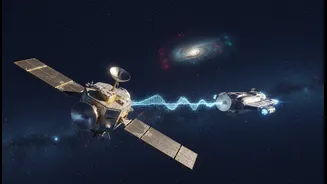
A space observatory is a lonely outpost, but it must constantly talk to its creators back on Earth. The problem is that this communication can interfere with its own observations. The high-power radio transmitters used to send vast amounts of scientific data across millions of kilometres can create electromagnetic interference (EMI) that pollutes the very sensitive electronics on board. It’s like trying to listen for a pin drop while standing next to a concert speaker. This interference can disrupt the delicate detectors and control systems that are essential for keeping the telescope stable and the coronagraph working perfectly. Mission designers must therefore carefully shield the scientific instruments and plan communication schedules that minimise conflict with sensitive observation periods, effectively telling the telescope when to listen to the stars and when to talk to Earth.
Engineering for Absolute Silence
Solving these challenges is the focus of intense research and development for NASA's next generation of planet-finders, like the Habitable Worlds Observatory. Building on lessons from the Hubble, James Webb, and the upcoming Nancy Grace Roman Space Telescopes, engineers are designing highly advanced 'active' coronagraphs with deformable mirrors that can change shape thousands of times per second to cancel out stray starlight. They are developing new materials with ultra-low thermal expansion and multi-zone heating systems to maintain picometer-level stability. Every system, from the structural supports to the data processors, is being reimagined to operate in near-perfect silence. The technologies being tested will push the boundaries of what's possible, from improved low-noise detectors to entirely new concepts for maintaining stability over long observation periods.