




The Classic Canine Conundrum
It’s a scene familiar to many dog parents in India. At home, your furry friend is a model student, responding to 'sit', 'stay', and 'come' with near-perfect accuracy. But the moment you step into a bustling city park, visit a relative’s house, or take
a trip to the hills, it’s as if their training vanishes. Suddenly, your voice is just another sound in the cacophony, and your commands go completely ignored. This common experience has led many to believe that dogs are creatures of habit who are poor at applying what they've learned in one place to another. We often assume they are highly context-dependent, meaning the command 'sit' is only understood on the living room rug, not on the grassy lawn of a holiday bungalow. This can be frustrating, but it also raises a fascinating question: Do dogs really not understand, or is something else at play?
Unpacking Canine Generalisation
Recent studies in dog cognition are turning this old assumption on its head. The scientific term for applying a learned skill in a new situation is 'generalisation', and it was long thought to be a significant cognitive hurdle for most animals. However, research now shows that dogs possess a remarkable ability to generalise human cues across different contexts. In controlled experiments, dogs trained to follow a specific human gesture, like pointing, in one room were then tested in a completely different environment with new sights and smells. While their performance sometimes dipped slightly, the majority of dogs still understood and followed the cue. This indicates that they aren't just associating a sound or a gesture with a specific location. Instead, they are grasping the communicative intention behind the cue itself. This ability is seen even in young puppies with limited training, suggesting it might be an innate skill sharpened by domestication.
More Than Just Commands
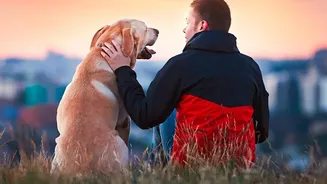
This cognitive flexibility goes far beyond simple obedience commands. It speaks to the very nature of the dog-human bond. Scientists suggest that through thousands of years of evolving alongside humans, dogs have developed a special aptitude for reading our social signals. They are not just responding to the word 'walk' but are reading our posture, the jingle of keys, and the excitement in our voice as part of a larger, meaningful picture. Studies have found that this skill is so ingrained that dogs can follow human pointing gestures spontaneously, even in novel problem-solving situations they've never encountered before. This suggests they are not just performing a trained trick, but are actively trying to cooperate and communicate with us. Their ability to do this, even when the setting changes, shows that their relationship with their human is the most important context of all.
A Brain Sharpened by Domestication
The leading theory behind this incredible skill is the 'domestication hypothesis'. It proposes that during the process of domestication, humans consciously or unconsciously selected dogs that were better at understanding our social and communicative cues. This created an evolutionary pressure that favoured dogs with a more human-like social cognition. Some research even points to a genetic component, finding that a significant percentage of a puppy's ability to follow human gestures can be attributed to its genes. This doesn't mean training is irrelevant. Rather, it suggests that when we train our dogs, we are not building a skill from scratch but are refining and nurturing a natural talent. The dog's brain is already wired to pay attention to us; our job is simply to make our communication clear and consistent.
Putting It into Practice
Understanding this can change how we interact with and train our dogs. Instead of getting frustrated when your dog seems distracted in a new place, view it as an opportunity to strengthen their natural skill of generalisation. The key is to start small. Practice familiar commands in different rooms of your house, then in your garden, and then in a quiet, nearby lane before venturing into a busy market. Keep training sessions short and positive, with plenty of praise and high-value treats. By gradually exposing them to various environments, you help them build a strong history of reinforcement that says, 'My human's cues are important and rewarding, no matter where we are'. This approach works with their brain, not against it, building a more confident and reliable companion.