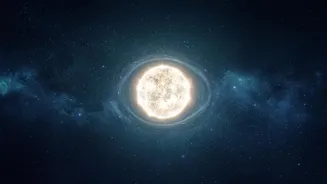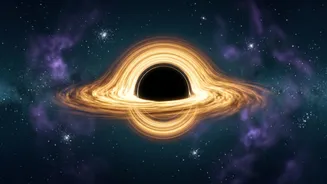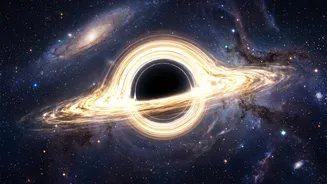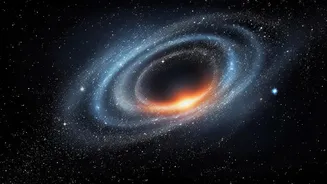



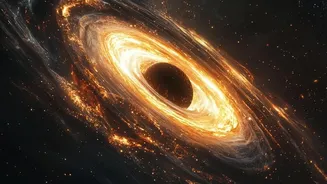
Our Milky Way galaxy is a sprawling city of stars, gas, and dust, but it holds a dark secret. Scientists estimate it should be home to around 100 million black holes, yet we have found only a tiny fraction. Where are the rest?
The Galaxy's Ghostly Residents
When we think of black holes,
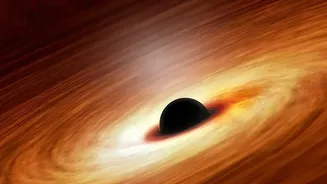
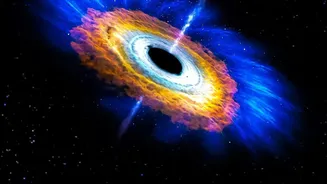
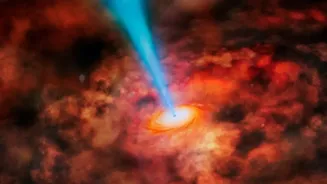
we often picture cosmic monsters actively devouring nearby stars, a process that releases tremendous amounts of energy and light, making them visible to our telescopes. These are the 'active' black holes. But most of the black holes in the Milky Way are believed to be 'dormant' or 'quiescent'. They are not feeding on a companion star, so they don't produce the bright accretion disks or jets of radiation that would give away their location. They are effectively invisible, drifting silently through the galaxy. This is the population of 'missing' black holes that scientists are so eager to find. Theory predicts that our galaxy has created about 100 million of these stellar-mass black holes over its lifetime, but so far, we have only confirmed the existence of around 70 to 100 of them. Finding the missing millions is a monumental task, but one that is crucial for understanding how massive stars live and die, and how our galaxy itself was assembled.
Introducing the Cosmic Detectives
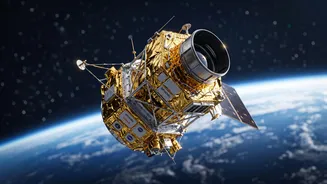
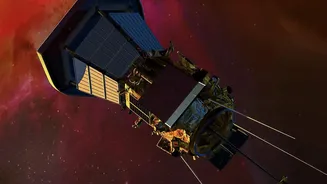
The hunt for these invisible giants is being led by new tools and techniques. A key player is the European Space Agency's Gaia spacecraft. Gaia's primary mission is to create an ultra-precise three-dimensional map of our galaxy by measuring the positions and motions of billions of stars with incredible accuracy. While Gaia cannot see a dormant black hole directly, it can spot its subtle gravitational influence on a visible companion star. If a star is part of a binary system with a black hole, it will 'wobble' in a predictable way as it orbits its unseen, massive partner. By detecting this wobble, astronomers can infer the presence of the black hole and even calculate its mass. This astrometric method has already proven successful, leading to the discovery of several dormant black holes, including a 'sleeping giant' named Gaia BH3, which has a mass nearly 33 times that of our Sun.
A New Way to See the Invisible
Another innovative technique being employed by 'black hole hunters' is the search for gravitational microlensing events. According to Einstein's theory of general relativity, a massive object's gravity can bend and magnify the light from a more distant object that passes behind it. In a binary system where a black hole orbits a star, if the black hole passes in front of its companion from our point of view, its gravity will briefly act like a lens, causing the star's light to flare in brightness. This distinct, short peak in brightness is a tell-tale sign of a hidden black hole. Projects like 'Black Hole Hunters', a citizen science initiative, are sifting through data from telescopes like NASA's TESS (Transiting Exoplanet Survey Satellite). The project uses artificial intelligence to flag potential candidates from millions of stars and then asks volunteers to help spot the characteristic light patterns that could signify a black hole.
Why This Cosmic Census Matters
Finding these missing black holes is about more than just completing a celestial collection. Creating a comprehensive census of our galaxy's black hole population will provide invaluable data to test and refine our theories of stellar evolution. For example, the masses of these black holes can confirm or challenge our understanding of how the most massive stars collapse. Discoveries like Gaia BH3, a black hole significantly more massive than stellar-origin black holes previously found in our galaxy, already pose a challenge to existing models. Furthermore, understanding the distribution and properties of these objects will help us piece together the history of the Milky Way, revealing more about its formation and the dynamic processes that have shaped it over billions of years. Each new discovery is a clue, helping to solve one of the grandest mysteries of our cosmic neighbourhood.