



Your Eyes Are a Time Machine
It sounds like science fiction, but it's a fundamental truth of our universe. Light, while incredibly fast, doesn't travel instantaneously. It moves at a staggering speed of nearly 3,00,000 kilometres per second. That means when we look at any object,
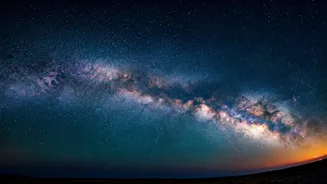
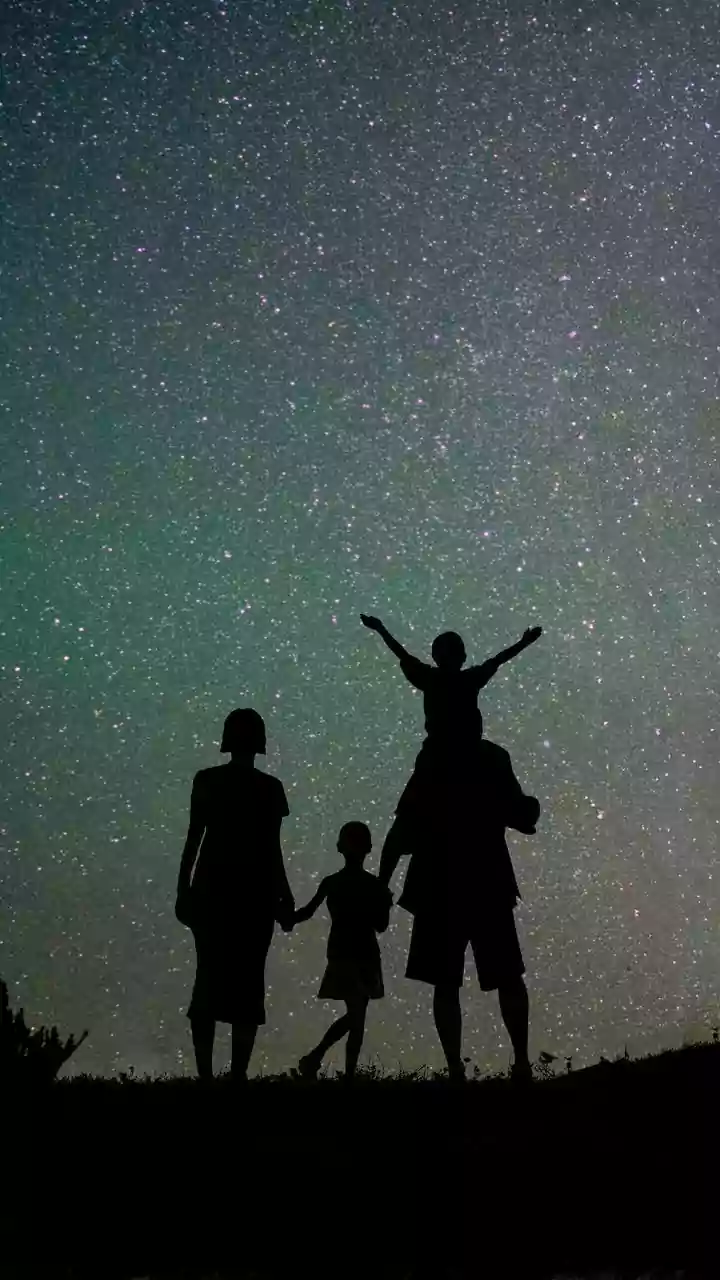
we are seeing it as it was in the past—the time it took for its light to reach our eyes. For objects on Earth, this delay is a tiny fraction of a second, completely unnoticeable. But when you look at the stars, you're dealing with unimaginable distances. To measure them, astronomers use a unit called a 'light-year'—the distance light travels in one year, which is about 9.5 trillion kilometres. So, if a star is 100 light-years away, the light you see from it tonight actually left that star 100 years ago. Every star in the night sky is a postcard from the past.
Postcards From India's History
Let's make this real. Find Polaris, the North Star, known in India as Dhruva Tara. It's a celestial guidepost that has been used for navigation for centuries. Polaris is approximately 433 light-years away from Earth. This means the light hitting your retina tonight left the star around the year 1591. At that time, the Mughal Empire was flourishing under Akbar's reign, and construction of the Charminar in Hyderabad had just been completed. You are literally seeing the star as it was during a pivotal moment in Indian history. Similarly, the bright star Vega, part of the Lyra constellation, is about 25 light-years away. Its light is from the late 1990s—a time when India was entering a new era of economic liberalisation and the internet was just beginning to take hold in our homes. The sky is not just a canvas of stars; it's a living museum of time.
Giants of a Bygone Era
The headline's 'hundreds of years' is actually quite modest for many stars. Consider Betelgeuse, the bright red star in the Orion constellation, known as Thiruvathirai or Ardra in Indian astronomy. It is a red supergiant located roughly 640 light-years away. The light we see from it tonight embarked on its journey around the 1380s, a time when the Delhi Sultanate was in decline and the Vijayanagara Empire was a dominant power in the South. What’s more, astronomers believe Betelgeuse is nearing the end of its life and could explode in a supernova anytime in the next 100,000 years. Because of the light-travel delay, it's entirely possible that it has already exploded—600 years ago—and we are just waiting for that explosive news to reach us. Every night, we look at Betelgeuse, unaware if we are seeing a star that is still shining or the ghost of a star that died centuries ago.
Why This Cosmic Delay Is a Gift
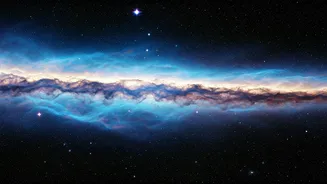
This time-lag isn't a bug; it's the greatest feature of the universe for astronomers. It allows them to study cosmic history directly. When they point powerful telescopes like the James Webb Space Telescope at extremely distant galaxies, they aren't just looking far away in space; they are looking billions of years back in time. They can see galaxies as they were when the universe was in its infancy, shortly after the Big Bang. This is how we have learned about how the first stars and galaxies formed. The light from these ancient objects carries clues about the conditions of the early universe. By studying this 'old light', scientists can piece together the complete 13.8-billion-year story of our cosmos, from its fiery birth to the present day. Your simple act of stargazing is, in a way, participating in this same act of cosmic time travel.