
The Cosmic Curtain of Dust
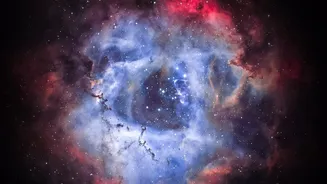
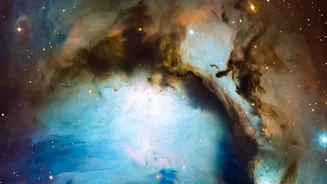
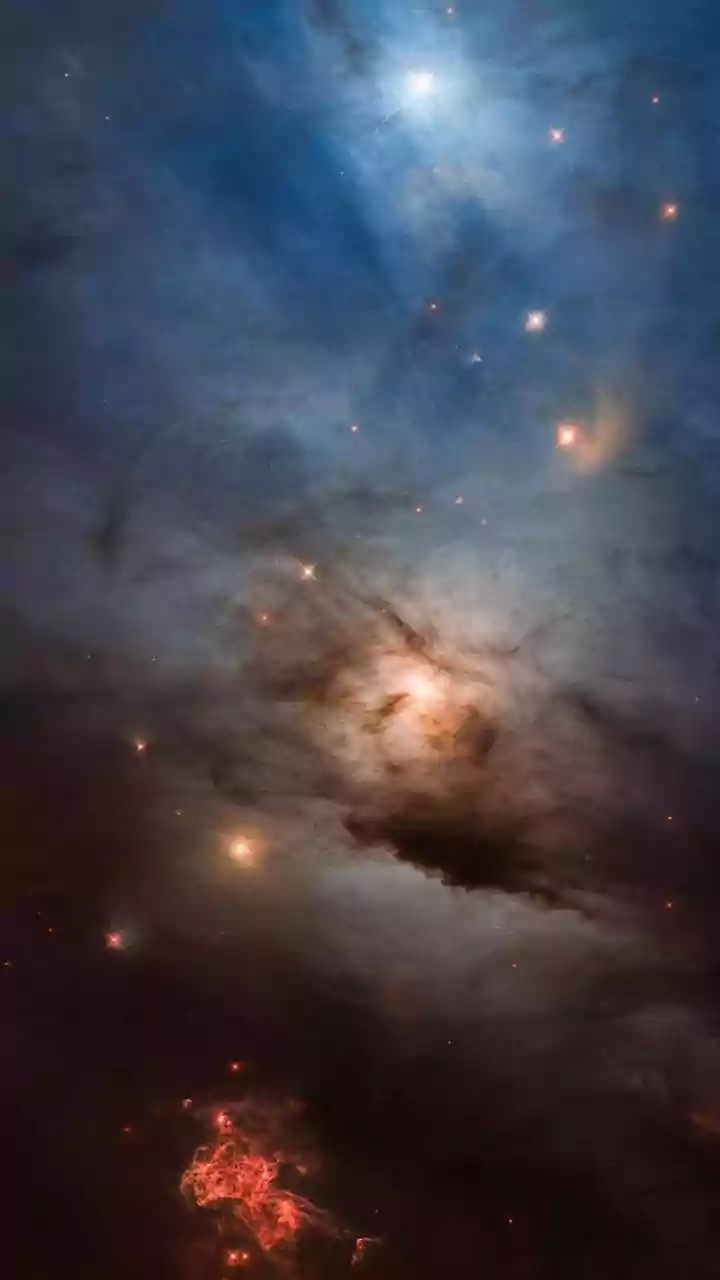
Across our galaxy and others, there are vast, cold clouds of gas and dust. Known as molecular clouds or stellar nurseries, these are not like the dust bunnies under your bed. Spanning many light-years, they are dense collections of hydrogen gas and tiny
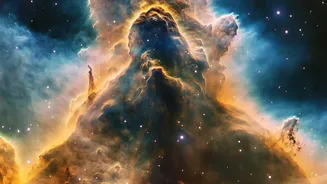
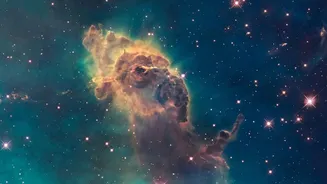
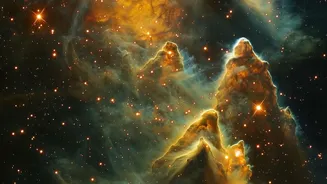
particles of silicates and carbon. These clouds are the raw materials for future stars and planets. However, they pose a major problem for astronomers because they act like a thick fog, scattering and absorbing visible light. This makes it impossible for traditional telescopes, which see the same light our eyes do, to observe the stellar creation happening deep inside. Iconic structures like the famous Pillars of Creation are beautiful, but in visible light, they are largely opaque pillars of gas and dust, hiding the action within.
Seeing the Unseen with Infrared Light
The secret to peering through this cosmic dust lies in looking at a different kind of light: infrared. Light exists across a broad spectrum of wavelengths, and our eyes can only see a tiny fraction of it. Infrared light has longer wavelengths than visible light. This is key, because while the small particles in cosmic dust clouds are very good at blocking the shorter wavelengths of visible light, the longer wavelengths of infrared can pass through much more easily. Think of it like sound traveling through a wall; you can often hear the deep, long-wavelength bass from music next door, while the higher-pitched sounds are muffled. In the same way, infrared radiation can penetrate the dust, allowing astronomers to see what's on the other side.
The Ultimate Star-Gazing Tool
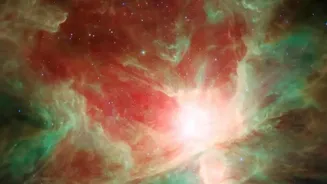
Enter the James Webb Space Telescope (JWST). While its predecessor, the Hubble Space Telescope, is famed for its stunning visible-light images, JWST was specifically designed to be the premier observatory for infrared astronomy. Its massive, 21-foot-wide mirror is engineered to collect faint infrared light from the most distant and hidden corners of the universe. Any visible light emitted by a newborn star, or protostar, is often absorbed by the surrounding dust. This dust then warms up and re-emits that energy as infrared radiation—a heat glow that JWST's instruments, like the Near-Infrared Camera (NIRCam) and Mid-Infrared Instrument (MIRI), are perfectly tuned to detect. This allows Webb to see not just through the dust, but to see the glow of the dust itself, revealing the structures where stars are forming.
Inside a Stellar Nursery
Webb's view of the Pillars of Creation provides a stunning example of this power. Where Hubble saw majestic, dark columns, Webb's infrared image reveals the stars forming within them. Bright red orbs, the tell-tale sign of newly formed protostars, are scattered throughout the scene, many still wrapped in their dusty cocoons. These young stars are estimated to be just a few hundred thousand years old. Wavy, lava-like features at the edges of the pillars show jets of material being ejected by these active young stars as they grow. By combining near-infrared images, which show the stars, and mid-infrared images, which highlight the glowing dust, astronomers get a complete, multi-layered view of the entire star-forming process that was previously hidden.
From Pictures to Physics
These breathtaking images are far more than just pretty pictures. They are rich data sets that allow scientists to revolutionize their models of star formation. By analyzing the different wavelengths of infrared light, astronomers can determine the precise number, age, and mass of the forming stars in a region. They can study how these stars interact with their environment, sending out powerful winds and jets that shape the surrounding cloud. Furthermore, infrared spectroscopy can reveal the chemical composition of the gas and dust, identifying key ingredients for life like water, carbon dioxide, and various organic molecules that exist in these stellar nurseries and the protoplanetary disks that will one day form planets.