


Meet the Cosmic Neighbour
At about 11 to 13 million light-years away, Centaurus A is one of our closest galactic neighbours. In cosmic terms, that's practically next door. Despite its proximity, it has always been an object of fascination and mystery. First identified in 1826,
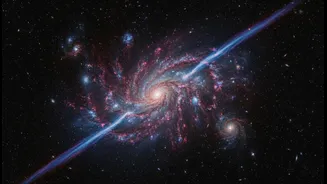
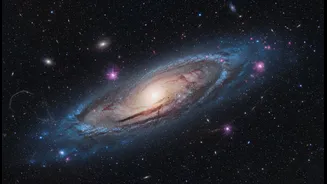
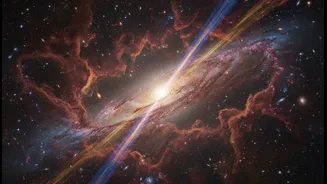
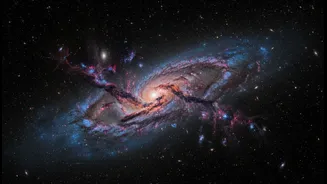
it wasn't until 1949 that astronomers realised it was one of the brightest sources of radio waves in the sky. Unlike neat and tidy spiral galaxies like our own Milky Way, Centaurus A is classified as a peculiar galaxy. Its appearance is the result of a violent galactic car crash: a large elliptical galaxy collided with a smaller spiral galaxy roughly two billion years ago. This cosmic merger left behind a chaotic jumble of star clusters, imposing lanes of dark dust, and a very active core.
Webb's Big Anniversary Reveal
For its fourth science anniversary, NASA aimed the most powerful space telescope in history, the James Webb Space Telescope (JWST), at this galactic marvel. The result is the most detailed image of Centaurus A ever captured. Previous telescopes like Hubble were blinded by the galaxy's thick, central dust lanes, which block visible light. NASA's Spitzer Space Telescope could see in infrared but couldn't resolve the fine details. Webb’s powerful infrared vision, however, cuts through the dust like a hot knife through butter. What was once an obscured, fuzzy region is now revealed as a dense tapestry of millions of individual stars, glowing gas, and intricate dust structures.
Decoding the Galactic Message
So, what is Centaurus A telling us in this new image? The key is in the details. For the first time, astronomers can see individual stars within the dusty, chaotic heart of the galaxy. By studying these stars, scientists can create a timeline of the galaxy's evolution, pinpointing when bursts of star formation happened after the ancient collision. The new images clearly show glowing, reddish-purple areas which are stellar nurseries where new stars are born, and older stars are shedding material. Webb’s instruments also revealed a strange, parallelogram-shaped structure of dust and a delicate S-shaped feature near the core, offering new clues about the aftermath of the galactic merger.
The Black Hole at the Centre of It All
At the heart of Centaurus A sits an active supermassive black hole, with a mass of about 55 million times that of our sun. This cosmic engine is actively feeding on the surrounding gas and dust, leftover from the galactic merger. As it consumes material, it blasts out enormous jets of energy and particles at nearly half the speed of light. The new Webb data allows scientists to study the complex relationship between the black hole and its host galaxy. It reveals how the black hole's activity can both trigger star formation by compressing gas, and also stifle it by violently blowing away the necessary raw materials. It's a dramatic push-and-pull that shapes the entire galaxy.