



A Telescope Unlike Any Other
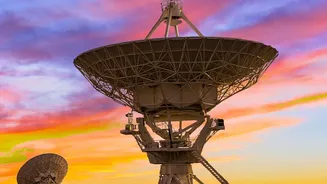
The instrument behind this incredible detection is the Canadian Hydrogen Intensity Mapping Experiment, or CHIME. Located in British Columbia, it doesn't look like a typical satellite dish. Instead, CHIME consists of four massive, stationary half-pipe
cylinders, each 100 metres long. With no moving parts, it surveys the entire northern sky every single day as the Earth rotates. This unique design gives it a huge field of view, making it exceptionally good at catching fleeting, unpredictable events that other telescopes might miss. Originally designed to map the hydrogen gas that fills the universe, scientists quickly realised CHIME was also a perfect machine for hunting down mysterious cosmic flashes.
Hunting for Cosmic Phantoms
For years, astronomers have been puzzled by phenomena known as Fast Radio Bursts, or FRBs. These are incredibly intense, but extremely short, blasts of radio waves that originate from deep space, lasting only a few milliseconds. In that fraction of a second, an FRB can release as much energy as our sun does in three days. Since the first one was discovered by chance in 2007, thousands have been detected, but their exact cause remains a major puzzle in astrophysics. Theories range from hyper-magnetised neutron stars called magnetars to colliding black holes. Because CHIME scans such a large patch of sky constantly, it has become the world's leading FRB detector, single-handedly discovering hundreds of them and dramatically expanding our catalogue of these enigmatic signals.
The Ancient Message
The recent breakthrough isn't just about spotting another FRB, but about a different kind of signal. The CHIME team successfully detected the faint, collective radio glow of neutral hydrogen gas from a time when the universe was only about five billion years old. This is a message from the cosmos nearly nine billion years ago. The technical achievement is monumental. This faint hum of ancient hydrogen is usually drowned out by much louder radio noise from our own galaxy and even from the telescope's own electronics. By developing new data-processing techniques, the team was able to isolate this primordial signal using CHIME's observations alone, a crucial step that proves the telescope's independent power.
A New Cosmic Yardstick
Detecting this ancient hydrogen glow opens a completely new path for research. By mapping the distribution of this gas at different points in cosmic history, scientists can trace how the universe has expanded over time. This provides a novel tool to study one of the biggest mysteries in all of science: dark energy. Dark energy is the name given to the unknown force that is causing the expansion of the universe to accelerate. By creating a 3D map of matter across vast stretches of time, CHIME can help test competing theories about the nature of dark energy. This method is also a fraction of the cost of traditional galaxy surveys, which rely on visible light and can only see the brightest, most dense parts of the universe. CHIME's approach allows us to study the 'missing' matter that exists in the diffuse gas between galaxies.