




A Solution Born from Crisis
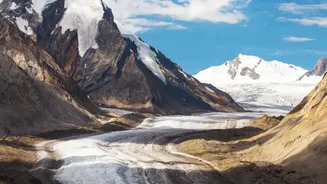
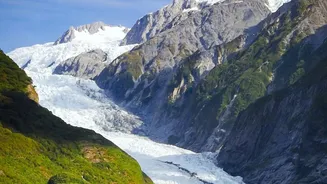
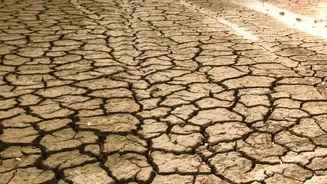
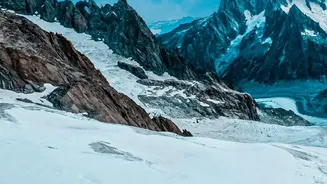
For generations, farmers in Ladakh have relied on a predictable rhythm. Winter snows would feed the mountain glaciers, which would then melt in late spring and summer, feeding the streams used to irrigate barley and wheat fields. But global warming has
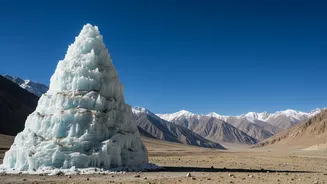
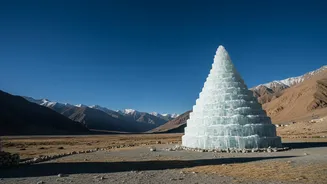
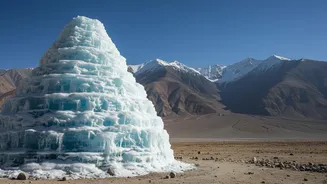
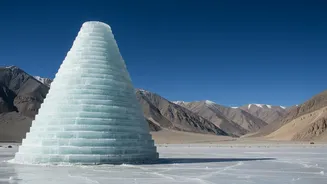
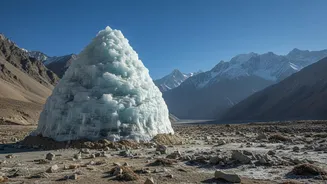
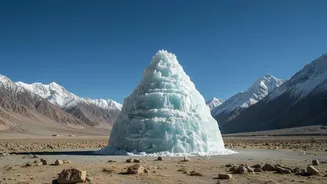
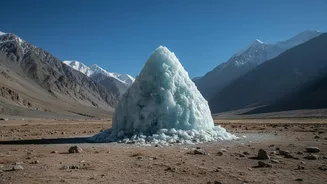
disrupted this cycle. Glaciers are receding, and the snow that does fall often melts too early in the season, leaving farmers without water during the crucial sowing period. In response to this crisis, Ladakhi engineer Sonam Wangchuk developed a revolutionary concept in 2013: the ice stupa. The idea is brilliantly simple. During the peak winter months, when stream water is abundant but largely unused, it is piped from a higher elevation. Gravity forces the water up through a vertical pipe at a lower altitude, where it sprays out and freezes in the sub-zero air, forming a massive, cone-shaped mound of ice that resembles a traditional Buddhist stupa. This vertical cone shape is key, as it minimizes the surface area exposed to direct sunlight, allowing it to melt much more slowly than a horizontal sheet of ice. The stored water is then released gradually throughout the spring, providing a vital lifeline for irrigation exactly when it is needed most.
First-Generation Challenges
The initial ice stupas were a resounding success, proving the concept could work and even helping to revive villages that had been abandoned due to water shortages. Competitions were launched to encourage communities to build their own, and the idea spread. However, these first-generation models were not without their difficulties. Construction was a labour-intensive process, requiring villagers to work in harsh winter conditions. The system was also vulnerable; if water froze inside the delivery pipelines, the entire stupa could fail. Efficiency was another concern. Studies showed that during construction, a significant percentage of the sprayed water could be lost before it turned to ice, a critical issue in a water-scarce region. These early stupas were a powerful proof-of-concept, but to make a lasting impact, they needed to become smarter, more efficient, and less dependent on manual intervention.
The Dawn of the Automated Stupa
The next phase in the evolution of ice stupas is automation. A Leh-based company, Acres of Ice, has recently deployed a fully automated ice reservoir in Igoo village, situated at 4,200 meters. This next-generation stupa is equipped with sensors, automated valves, a control panel, and a weather station, allowing it to be managed remotely with minimal human effort. The system uses data to operate with maximum efficiency. For example, it can automatically stop spraying if the wind is too high (which wastes water) or if temperatures rise above freezing. This automated system claims an efficiency of over 80 percent, meaning far more of the diverted stream water is successfully converted into ice. This leap in technology addresses the major drawbacks of the original design, reducing both the intense labour and the water wastage involved in the construction process. For local farmers, the results are immediate, providing a more reliable and abundant water supply for their fields during the critical spring planting season.
A Vision for a Greener Future
The evolution of the ice stupa is about more than just technology; it's about scaling the vision. Sonam Wangchuk and the Himalayan Institute of Alternatives (HIAL) see these projects not just as standalone solutions but as part of a wider strategy for regional sustainability. The goal is to create dozens more ice stupas, potentially creating a chain of artificial glaciers that can collectively recharge groundwater, support wider-scale plantations, and even create local microclimates. Beyond agriculture, the stupas have become symbols of climate resilience and have potential for eco-tourism. The project has also expanded internationally, with stupas being built in the Swiss Alps and experiments being conducted in other mountain regions like Chile. However, proponents like Wangchuk are quick to caution that these innovations are a form of adaptation, not a cure for climate change itself. They are a way to buy time and build resilience while pressing for the larger systemic changes needed to protect the Himalayan ecosystem.