


Why You Can't See the Rings Unassisted
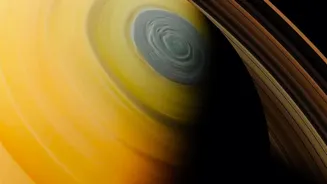
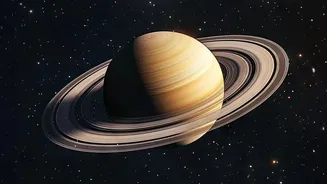
Saturn is currently about 1.26 billion kilometres from Earth. At that immense distance, it appears to us as one of the brightest objects in the sky, shining with a steady light that doesn't twinkle like stars do. This makes it relatively easy to spot.
However, the rings, despite spanning hundreds of thousands of kilometres, are simply too small and faint to be resolved by the human eye alone. You will see the planet, which looks like a bright, yellowish star, but its most famous attribute remains hidden, requiring a little help to bring it into focus. Think of it like seeing a ship on the horizon; you can tell it’s there, but you need a spyglass to see the details of its masts and sails.
Binoculars: A Glimpse, Not a Grand View
So, what about binoculars? They are a staple for amateur stargazers and certainly enhance the view. Pointing a steady pair of 10x magnification binoculars at Saturn will reveal something interesting: the planet no longer looks like a perfect point. Instead, it will appear slightly oval or elongated, like a tiny American football. This subtle distortion is the effect of the rings, but your brain and eyes will see them merged with the planet's disc. You'll know something is there, but you won't get the satisfaction of seeing the rings as a distinct structure separate from the planet. For that 'wow' moment, you need to step up your equipment.
The Telescope: Your Gateway to Saturn
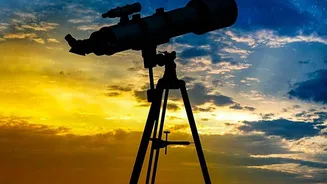
To truly see Saturn’s rings as a separate, floating structure, you need a telescope. The good news is that you don't need a professional observatory. Even a small beginner's telescope can do the job. The key factor is magnification. You'll need at least 25x to 40x magnification to clearly distinguish the rings from the planet itself. Many experts suggest that a magnification of 50x to 75x is where the view becomes truly rewarding, allowing you to see the rings detached on all sides from the planetary globe. A basic telescope with a 60mm to 80mm aperture is generally sufficient to achieve this, making the awe of Saturn accessible to most aspiring astronomers.
Choosing Your First Telescope
If you're buying your first telescope, the options can feel overwhelming. For viewing planets like Saturn, a small refractor telescope (the classic long, thin tube) or a reflector telescope (which uses mirrors) are both excellent choices. An aperture of at least 70mm to 100mm is a great starting point for a beginner. More important than raw power is a stable mount. A wobbly telescope makes focusing on a distant object like Saturn impossible. Look for a simple, sturdy alt-azimuth mount, which moves up, down, left, and right, and is very intuitive for beginners. Always start with your lowest power eyepiece (like a 25mm) to find and centre the planet before switching to a higher power (like a 10mm) to magnify the view.
A Rare Viewing Opportunity Is Changing
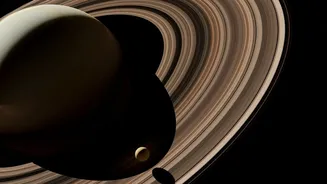
There’s a special reason to start your Saturn-gazing journey now. Because of Saturn's axial tilt, our view of the rings changes over its 29.5-year orbit around the Sun. In March 2025, Earth will pass through Saturn's ring plane, causing them to appear perfectly edge-on. From our perspective, they will seem to vanish entirely for a period. While this ring plane crossing itself will be difficult to observe as Saturn will be too close to the Sun, the lead-up and aftermath offer a unique sight. Throughout 2026, the rings will appear unusually thin, like a sharp, narrow line bisecting the planet—a view most people alive have never had. The rings won't appear wide and glorious again until around 2031, making the next few years a special, fleeting window to see a different side of the ringed giant.