

The Icy Giant’s Enduring Mysteries
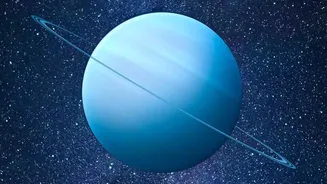
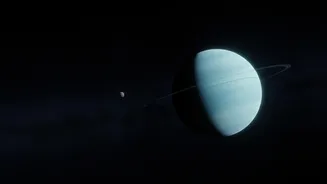
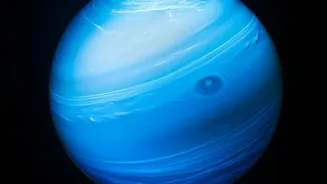
Uranus has always been the oddball of the solar system. It’s the only planet that spins on its side, with an axial tilt of nearly 98 degrees. This extreme tilt results in bizarre, 42-year-long seasons of continuous sunlight followed by an equal period
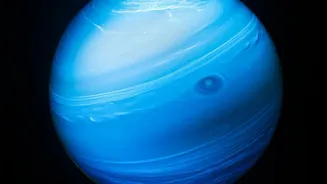
of darkness for its poles. Scientists suspect a colossal impact with an Earth-sized object in the distant past knocked it over, but the details remain fuzzy. Furthermore, Uranus is colder than its neighbour Neptune, even though Neptune is farther from the Sun, suggesting it has very little internal heat. Its magnetic field is also wildly off-centre and irregular. Since Voyager 2’s fleeting flyby in 1986, our only close-up look at the planet, these questions have largely remained unanswered. A new moon provides a fresh tool to probe these long-standing puzzles.
An Orbit as a Gravitational Map
To an astronomer, a moon's orbit is a story written in the language of gravity. Every celestial body follows the laws of physics, and a moon’s path is dictated by the gravitational pull of its parent planet and, to a lesser extent, its sibling moons. By precisely tracking the new moon's trajectory—its speed, its shape, and any tiny wobbles or perturbations—scientists can build an incredibly detailed map of the gravitational field around Uranus. This isn't just about confirming the planet's total mass; it's about understanding how that mass is distributed. The tiny gravitational tugs from other moons will also influence the new satellite's path, allowing for refined calculations of the masses of the entire Uranian system. This new moon acts as a sensitive, natural probe, reacting to forces that are invisible from Earth.
Probing the Planet’s Interior
One of the biggest questions about Uranus is what’s going on inside. Scientists believe it has a small, rocky core surrounded by a hot, dense fluid of 'icy' materials like water, methane, and ammonia. However, it's unknown if these layers are distinct or blur into one another. The way mass is arranged inside the planet directly affects its gravitational field. An unevenly distributed core or strange currents in its slushy mantle would create subtle gravitational anomalies. A small, nearby moon is particularly sensitive to these variations. By observing how the new moon’s orbit deviates from a perfect ellipse, researchers can infer the planet’s internal structure without ever sending a probe deep beneath its clouds. This helps test theories about whether the ancient impact that tilted Uranus also scrambled its interior, causing it to lose its primordial heat faster than other planets.
A Window into the Ring System
Planetary rings are not static structures; they are dynamic environments shaped by the moons that orbit among them. Small moons, often called shepherd moons, act as gravitational guides, keeping ring particles confined in narrow bands and creating sharp edges. The discovery of a new moon inside or near Uranus's faint, dark rings could explain features that have long puzzled scientists. For example, the composition of some of Uranus's rings doesn't match its known inner moons, hinting that undiscovered bodies are feeding them material. By studying the new moon's location and composition, scientists can determine if it is the source of a nearby ring or if its gravity is sculpting the rings in a particular way, much like how Saturn's tiny moons sculpt its magnificent rings.
Clues to a Violent Past
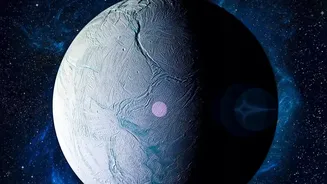
The orbits of moons can also serve as fossils, preserving evidence of a system's formation and history. Many scientists believe planetary rings are the remnants of moons that were shattered by collisions or torn apart by gravity. The new moon’s orbit might show a tell-tale inclination or eccentricity that suggests it was once part of a larger body that was destroyed. Its composition—whether it is icy like Saturn's moon Enceladus or darker and rockier—could link it to other moons or rings, helping piece together the family tree of the Uranian system. This is a top priority for planetary scientists, and a future Uranus Orbiter and Probe mission is being planned to investigate these very questions. This tiny moon provides a tantalizing preview of the discoveries that await.