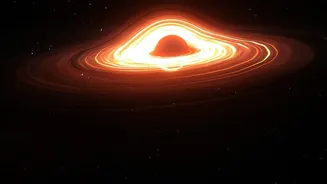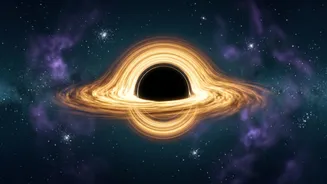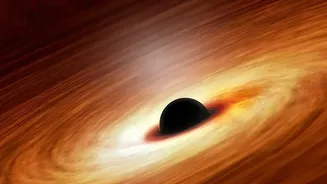



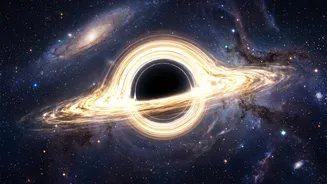
The Milky Way galaxy is believed to be teeming with millions of black holes, yet astronomers have located only a few dozen. A new project is betting that the key to finding these invisible giants isn't just a better algorithm, but the human eye.
The Galaxy's Missing Monsters
Black
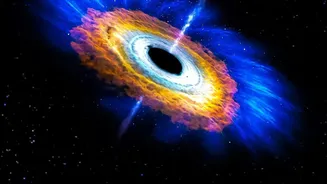
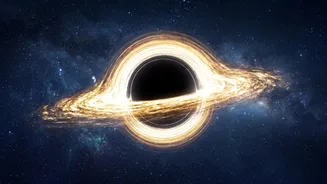
holes are the universe's ultimate ghosts. Formed from the collapsed remnants of massive stars, their gravitational pull is so immense that nothing, not even light, can escape, rendering them invisible. Astronomers know they exist primarily through indirect methods, such as observing material heating up and emitting X-rays as it's pulled in, or by tracking the strange orbits of nearby stars. However, these methods only work for 'active' or feeding black holes. The vast majority are thought to be 'dormant' or 'quiet', drifting silently through space without interacting with other matter. Models of stellar evolution predict there should be more than 10 million of these quiet black holes in our galaxy alone, but scientists have confirmed the locations of only about 70. This enormous gap highlights a fundamental challenge in astronomy: how do you find something that is actively hiding?
When Automation Hits a Wall
In the age of big data, the logical first step is to unleash artificial intelligence on the problem. Using data from planet-hunting telescopes like NASA's TESS, automated systems can scan millions of stars for clues. The primary technique involves looking for an effect called gravitational lensing. If a black hole passes between us and a distant star, its gravity can act like a magnifying glass, briefly making the star appear brighter. AI is trained to hunt for these tell-tale brightness spikes in 'light curves'—graphs showing a star's brightness over time. The problem is that stars are fickle. Many have natural variations in brightness that can mimic a lensing event, creating a flood of false positives. An AI system might flag a million potential candidates, an impossible number for a small team of astronomers to verify manually. This is where automated searches struggle; they lack the nuanced pattern-recognition ability to easily distinguish true signals from cosmic noise.
Enter the Citizen Scientist
To solve this problem, astronomers have turned to a powerful resource: people. A project called 'Black Hole Hunters', hosted on the citizen science platform Zooniverse, enlists volunteers to do what algorithms can't. Led by researchers from institutions like the University of Southampton, the project presents volunteers with the light curves that an AI has pre-screened. The task is simple and requires no background in astronomy. Volunteers look at graphs of stellar brightness and identify whether they see the specific, sharp peak characteristic of a gravitational self-lensing event, which occurs when a black hole repeatedly orbits a companion star. This human review process filters out the vast majority of false alarms, allowing professional astronomers to focus their powerful telescopes only on the most promising candidates.
The Power of the Human Brain
The human brain remains one of the most sophisticated pattern-recognition machines in existence. While an algorithm must be explicitly programmed, a person can quickly learn to spot the subtle visual difference between a genuine signal and stellar variability. The Black Hole Hunters project leverages this by showing volunteers examples of what to look for, effectively training a distributed network of thousands of human minds. Since its launch, nearly 23,000 volunteers have made almost 12 million classifications, demonstrating the incredible power of collaborative, people-powered research. This approach doesn't just speed up the process; it makes discoveries possible that might otherwise be lost in a sea of data. According to Dr. Adam McMaster, one of the project's co-leads, volunteers will remain a crucial part of the search, working in coordination with machine learning models.