





Breathing on the Red Planet
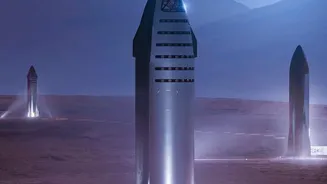
The dream of sending astronauts to Mars runs into a fundamental problem before anyone even steps on the spacecraft: oxygen. It’s not just for breathing; the largest consumer of oxygen on a Mars mission would be the rocket needed for the return journey.
Launching a crew from the Martian surface requires immense amounts of liquid oxygen (oxidizer) mixed with fuel. Transporting all that oxygen from Earth is logistically challenging and prohibitively expensive. The answer lies in a concept called In-Situ Resource Utilization (ISRU), which is a technical term for living off the land. The most critical resource to produce on Mars is oxygen, and its atmosphere, which is 96% carbon dioxide (CO2), is the perfect raw material. By breaking down CO2 molecules, researchers can harvest the oxygen atoms within.
MOXIE: A Toaster-Sized Proof of Concept
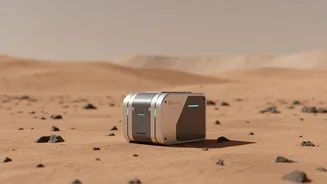
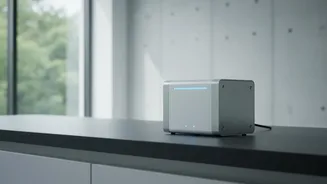
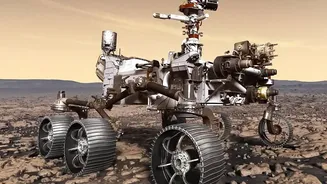
The first major breakthrough in this field happened on April 20, 2021, when a small, golden box aboard NASA's Perseverance rover made history. The Mars Oxygen In-Situ Resource Utilization Experiment, or MOXIE, successfully produced oxygen on another planet for the first time. Developed through a collaboration including MIT and NASA's Jet Propulsion Laboratory, MOXIE works using a process called solid oxide electrolysis. It inhales the thin Martian air, heats it to around 800 degrees Celsius, and then uses an electrochemical process to split the CO2 molecules into pure oxygen and carbon monoxide, which is then vented away. Over its mission, MOXIE proved the technology was viable, producing about 122 grams of oxygen in total—enough to keep a small dog alive for 10 hours. While modest, it was a monumental success, proving that the basic science works in the harsh Martian environment.
The Challenge: From a Toaster to an Oxygen Factory
While MOXIE was a triumph, it was always intended as a small-scale demonstration. It produced oxygen at a rate of about 6-12 grams per hour. To support a human mission, including generating the 30 tons of oxygen needed for a Mars Ascent Vehicle, future systems will need to produce oxygen at a rate of kilograms per hour. This is the central challenge for planetary researchers: scaling up the technology. A full-scale system would require about 25 to 30 kilowatts of power, far more than a rover can provide. Researchers are now working on next-generation Solid Oxide Electrolysis (SOXE) stacks that are vastly more powerful. Companies like OxEon Energy, which worked on MOXIE, have been developing stacks that are over 30 times the scale of the original device. These involve increasing the cell area and stacking more cells together to dramatically boost output.
Building a Better Oxygen Generator
Scaling up isn't just about making things bigger; it's about making them more efficient, durable, and reliable for long-duration missions. A key area of research is improving the materials. The electrolysis process happens at extreme temperatures, which puts a lot of stress on the components. Scientists are investigating new materials for the electrodes and electrolytes to improve stability and redox tolerance, which is the ability to withstand the chemical reactions without degrading. Another crucial innovation is designing better interconnects—the components that link the individual electrolysis cells into a stack. New designs allow for a better seal to collect the pure oxygen, ensuring a purity of 99.9% or higher, which is essential for both life support and rocket propellant. These mission-scale systems will be designed to run continuously, unlike MOXIE which operated in short bursts. They will also need to be integrated with systems to liquefy and store the oxygen, a complex process in its own right.
The Road Ahead: Combining Technologies
The ultimate goal is to create an integrated system. Some advanced concepts involve combining oxygen production from the atmosphere with electrolysis of water extracted from Martian ice. This co-electrolysis process could produce not only oxygen but also hydrogen, which can be reacted with carbon monoxide (a byproduct of CO2 electrolysis) to create methane. Oxygen and methane can be used as a highly efficient rocket propellant combination, meaning future astronauts could manufacture their entire return fuel supply on Mars. While these technologies are still in development, with test systems being run in Mars simulation chambers on Earth, they represent the next logical step. It’s no longer a question of if we can make oxygen on Mars, but how efficiently and abundantly we can produce it to support a sustained human presence.