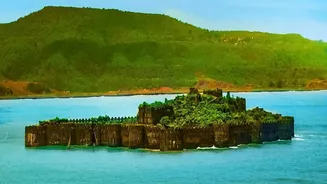





Perched on an island off Maharashtra’s coast, the Murud-Janjira Fort is a marvel of military engineering. Its mighty stone walls have stared down the Arabian Sea for centuries, earning a legendary reputation as the fort that was never conquered.
An Unconquered Citadel
Imagine
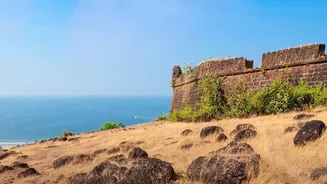
a fortress so formidable that no enemy could ever breach its walls. Not the ambitious Marathas, not the colonial Portuguese, and not the mighty British. That is the legacy of Murud-Janjira, an imposing sea fort located on an oval-shaped rock near the coastal village of Murud. For centuries, this stronghold remained an independent bastion, a testament to its brilliant design and the resilience of its defenders. Its name itself tells a story, combining the Arabic 'Jazira' (island) with the local Konkani 'Morod' for a similar meaning. Even today, battered by sea winds and tides, its 40-foot-high walls and 19 rounded bastions remain largely intact, a powerful silhouette against the horizon.
The Siddi Dynasty's Stronghold
The fort's history is inseparable from the Siddis, rulers of African descent who established a powerful, independent state on the Konkan coast. While a wooden structure was first built by local Koli fishermen in the 15th century to defend against pirates, it was Malik Ambar, a brilliant Siddi regent of the Ahmadnagar Sultanate, who commissioned the stone fortress in the 16th century. The Siddis, who had arrived in India as soldiers and traders, leveraged their exceptional naval skills to become formidable rulers. They governed Janjira as an autonomous state until it became part of India in 1947, successfully repelling every power that sought to claim their island prize.
A Masterpiece of Military Architecture
Janjira's invincibility was no accident; it was the result of ingenious strategic design. The main gate is cleverly concealed, only becoming visible to approaching boats at very close range, making a surprise attack nearly impossible. A smaller rear gate, the 'Darya Darwaza', provided a secret escape route to the sea. Inside the sprawling complex, ruins of palaces, officers' quarters, and a mosque hint at the bustling society that once thrived within its walls. Remarkably, the fort contained two large freshwater ponds, a vital feature that allowed its inhabitants to withstand long sieges without needing external supplies. Its ramparts still hold massive cannons, like the famous 'Kalaal Baangadi', silent witnesses to the fort's storied past.
Legends of Defiance
The history books are filled with tales of failed attempts to capture Janjira. Chhatrapati Shivaji Maharaj, the legendary Maratha king, reportedly tried and failed on multiple occasions. His son, Sambhaji Maharaj, even attempted to build an underwater tunnel to the fort, an ambitious project that also fell short. As a countermeasure, Sambhaji built the Padmadurg fort on a nearby island to challenge Janjira's dominance, but the Siddi stronghold remained unbreached. Flanking the main gate is a sculpture of a tiger-like beast clawing at elephants, a powerful symbol of the fort's fierce and unyielding spirit.
Visiting Janjira Today
Today, Murud-Janjira is a popular tourist destination, accessible via a short sailboat ride from the Rajapuri jetty near Murud town, about 165 km south of Mumbai. The journey itself offers a dramatic approach to the sea-swept walls. Visitors can explore the labyrinthine passages and climb the bastions for breathtaking panoramic views of the Arabian Sea. Though now in ruins, the fort offers a tangible connection to a unique chapter of Indian history. The best time to visit is between October and March, when calm seas and pleasant weather make for an ideal trip.