

Saturn Nears Its Brightest
The star of the show this late August is undeniably Saturn. The ringed planet is currently gliding towards its annual opposition, which will occur on October 4. Opposition is the point when Earth passes directly between the Sun and an outer planet, making
it appear at its biggest and brightest in our sky for the entire year. In late August, Saturn will be exceptionally bright and well-positioned for viewing in the evening. Rising in the east as the sun sets, it will be visible all night long, shining prominently in the constellation Cetus. While a telescope is needed to see its famous rings clearly, even a good pair of binoculars will reveal it as a distinct, glowing oval rather than a point-like star. This period is the perfect time to familiarise yourself with Saturn's position in the sky ahead of its peak performance in early October.
Behold the Milky Way
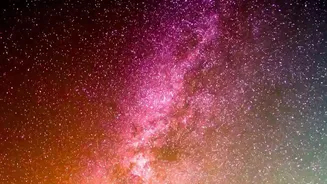
Late August provides an excellent window to witness the grandeur of our own galaxy, the Milky Way. For observers in India, the dense, bright central core of the galaxy is well-placed in the evening sky. To find it, first locate the prominent 'Summer Triangle' asterism, composed of the three bright stars Vega, Deneb, and Altair. The Milky Way cuts right through this triangle. From a location away from city lights, it appears as a faint, hazy band of light stretching across the sky. The period between August and September is ideal for viewing it just a couple of hours after sunset. The key to a memorable sighting is escaping light pollution. A trip to a darker, rural area can transform a faint smudge into a breathtaking river of stars. The air, often washed clean by monsoon showers, can lead to exceptionally clear viewing conditions on cloudless nights.
Last Call for the Perseids
The famous Perseid meteor shower had its spectacular peak around August 12-13, offering a fantastic display under moonless skies. However, the show isn't completely over. The shower remains active until about August 24, meaning patient observers can still catch some celestial fireworks in the latter half of the month. While the rate of meteors will have dropped significantly from the peak's 50-100 per hour, you can still spot stray Perseids streaking across the sky. For the best chance, find a dark location after midnight and look towards the northeast. These late-season meteors can often be bright and are a rewarding sight for those who put in the time. Give your eyes at least 20 minutes to fully adapt to the darkness for the best experience.
Planetary Parade in the Morning
For the early risers, the pre-dawn sky holds its own set of treasures. While a major six-planet alignment was a highlight around August 12, several of these worlds remain visible. In the hours before sunrise, you can still spot bright Mars and Saturn. Mars will be relatively high and easy to see with the naked eye. Jupiter and Mercury will be much lower towards the eastern horizon, presenting a greater challenge as they compete with the approaching dawn. Seeing these planets requires a clear, unobstructed view of the eastern horizon. Using a stargazing app on your phone can be an invaluable tool for identifying each planet and knowing exactly where to look as the sky begins to brighten. Even if you only catch one or two, witnessing the planets before the sun rises is a magical experience.