




Meet K2-18b: A 'Hycean' World
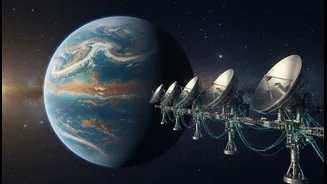
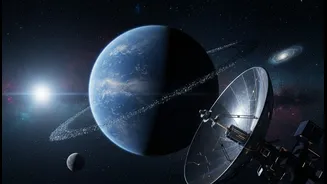
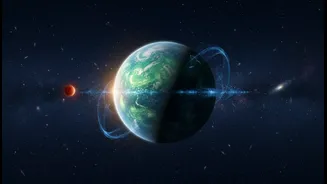
K2-18b is an exoplanet, meaning it orbits a star outside our solar system. Located in the constellation Leo, it is about 8.6 times more massive than Earth and orbits a cool red dwarf star. What makes K2-18b so special is that it resides in its star's
habitable zone, the region where temperatures are just right for liquid water to exist. Scientists believe it may be a 'Hycean' world—a relatively new and still theoretical class of planet characterized by a global liquid water ocean lying beneath a thick, hydrogen-rich atmosphere. Initial observations with the James Webb Space Telescope (JWST) have already confirmed the presence of carbon-bearing molecules like methane and carbon dioxide in its atmosphere, which is consistent with the Hycean model and further fueled interest in its potential for hosting life.
Listening for Life's Technosignatures
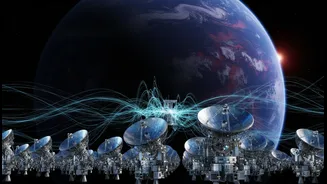
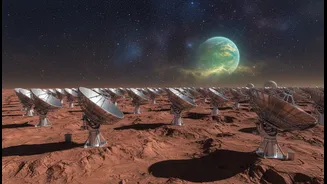
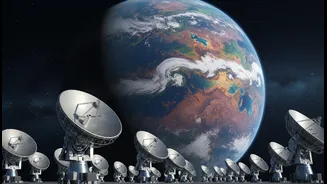
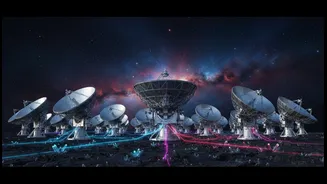
The headline's mention of a "radio survey" refers to a recent, targeted effort by the Search for Extraterrestrial Intelligence (SETI) community. Researchers used powerful radio telescopes, including the Very Large Array (VLA), to scan K2-18b for 'technosignatures'—signals that would indicate the presence of advanced technology, like radio transmissions. This massive search involved analyzing millions of potential signals, using advanced software to filter out interference from Earth and other cosmic noise. While no convincing artificial radio transmissions were found, the survey was far from a failure. It allowed scientists to set a firm upper limit on the strength of any potential transmitters on the planet, concluding that if a civilization is there, it isn't broadcasting with technology significantly more powerful than our own.
The Hunt for a Chemical Whisper
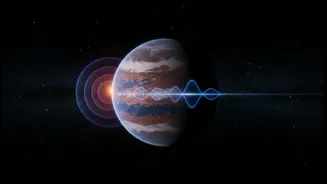
Parallel to the radio search, a different kind of survey using the James Webb Space Telescope (JWST) has yielded the most tantalizing clues. By analyzing starlight filtering through the planet's atmosphere—a technique called transmission spectroscopy—astronomers looked for chemical 'biosignatures.' This led to a stunning, though tentative, discovery: the possible presence of dimethyl sulfide (DMS). On Earth, DMS is a gas produced almost exclusively by life, primarily marine phytoplankton. This potential detection, while not yet confirmed to the rigorous 'five-sigma' standard of scientific discovery, is one of the most compelling hints of biological activity found on an exoplanet to date. However, scientists remain cautious, as some analyses suggest the signal could be statistical noise or that non-biological processes could potentially create DMS on such a different world.
A New Blueprint for Alien Hunting
Regardless of whether DMS is definitively confirmed on K2-18b, the combined efforts have established a powerful new methodology for astrobiological research. The K2-18b case represents a paradigm shift. The old standard was primarily focused on finding Earth-like planets in habitable zones. The new standard, demonstrated here, is a two-pronged attack on the most promising non-Earth-like candidates. First, conduct deep atmospheric analysis with tools like JWST to hunt for specific, complex biosignatures like DMS on promising Hycean worlds. Second, simultaneously conduct deep radio surveys for technosignatures to cover all possibilities. This comprehensive approach, testing for both simple biology and advanced technology, has proven to be a highly effective way to scrutinize a world for signs of life, creating a blueprint that will accelerate future searches across the galaxy.