

A Long Journey to an Ocean World
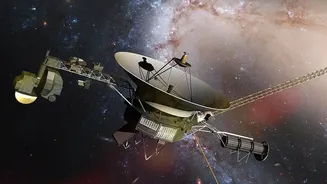
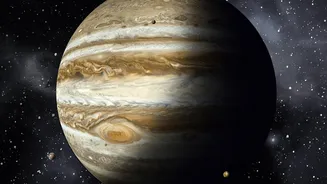
Launched in October 2024, the Europa Clipper spacecraft is currently on a 2.9-billion-kilometre voyage to the Jupiter system. But it's not a straight shot. To build up the immense speed needed for the journey, the probe is performing a series of cosmic
pirouettes, known as gravity assists. It flew by Mars in March 2025 and is scheduled for a final flyby of Earth in December 2026 before slingshotting toward the outer solar system. Arrival at Jupiter is expected in April 2030. It’s a mission that requires patience, but the potential scientific rewards are immeasurable. Once it arrives, Clipper won't orbit Europa directly due to the intense radiation from Jupiter. Instead, it will enter a long, looping orbit around Jupiter and perform nearly 50 close flybys of the moon, some as low as 25 kilometres above the surface.
The High-Tech Toolkit for the Job
The headline-making part of the mission is its ability to peer beneath Europa's thick ice shell. To do this, Clipper is outfitted with a sophisticated suite of nine scientific instruments. One of the most critical is an ice-penetrating radar instrument called REASON (Radar for Europa Assessment and Sounding: Ocean to Near-surface). This instrument will transmit radio waves through the ice, listening for a reflection from a liquid water ocean below. By analyzing these echoes, scientists hope to determine not only if the ocean exists, but also its depth and the thickness of the ice crust above it, which is estimated to be 15 to 25 kilometres thick. Another key instrument is a magnetometer, which will measure the magnetic field around Europa. Since a salty ocean would conduct electricity, it should create its own weak magnetic field in response to Jupiter’s powerful one, providing another line of evidence for its existence, depth, and salinity.
Mapping a World from Afar
So, while the spacecraft is not yet at Europa, its goal is indeed to create a comprehensive map—but not just of the ocean. The mission aims to characterize Europa's habitability as a whole. Its powerful cameras will map the majority of the moon's surface in high resolution, helping scientists understand its geology and scout for potential future landing sites. Other instruments, like spectrometers, will analyze the chemical composition of the ice, searching for salts and organic molecules that are essential building blocks for life. Some instruments will even sample Europa's tenuous atmosphere and any potential water vapor plumes that might erupt from the surface, which could offer a direct taste of the ocean's chemistry without having to drill through the ice. In essence, the mission is designed to create the first detailed portrait of an alien ocean world.
The Search for Habitable Conditions
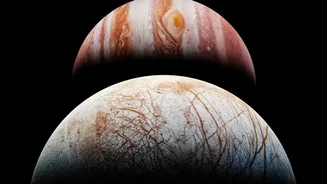
It’s important to clarify that Europa Clipper is not a life-detection mission. Its primary objective is to determine if the moon has the necessary ingredients for life as we know it: liquid water, essential chemical elements, and a source of energy. Data from previous missions like Galileo strongly suggests Europa has a global saltwater ocean containing more than twice the water of all of Earth's oceans combined. Scientists also hypothesize that there could be energy sources from hydrothermal vents on the seafloor, similar to those found on Earth. By confirming the ocean's properties and studying the moon's chemistry and geology, Clipper will help us understand if Europa represents a currently habitable environment. Answering that question is a monumental step, paving the way for future missions that could one day search for life itself.