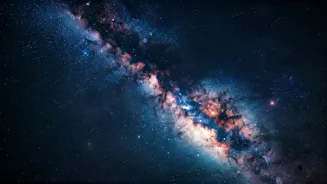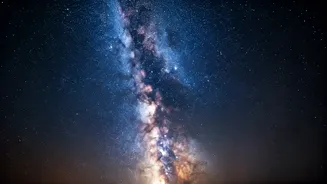




Your Eyes Are a Time Machine
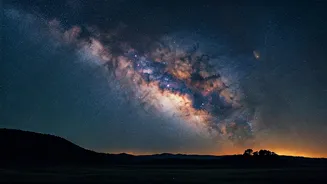
It sounds like science fiction, but it’s a fundamental truth of our universe. When you gaze at a star, you are not seeing it as it is right now. You are seeing it as it was when the light you’re observing first began its long journey across space. This
is because light, while incredibly fast, does not travel instantaneously. It moves at a constant speed of nearly 300,000 kilometres per second. That’s fast enough to circle the Earth more than seven times in a single second, but the distances between stars are so mind-bogglingly vast that it still takes light years, decades, centuries, or even millennia to reach us.A light-year is the distance light travels in one year—a staggering 9.46 trillion kilometres. So, when we say a star is 100 light-years away, it means the light we see from it tonight left that star 100 years ago. You are, quite literally, looking back in time.
Seeing Ghosts in the Sky
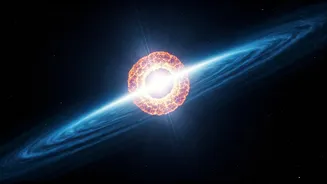
This cosmic delay has a fascinating implication. Some of the stars you see in the sky might not even exist anymore. Imagine a massive star 1,500 light-years away. If that star exploded in a supernova a thousand years ago, we wouldn't know it yet. For another 500 years, we would continue to see it shining peacefully in our night sky, completely unaware of its cataclysmic demise. Its light, a ghost of its former self, continues to travel towards us long after the source has vanished.This isn't just a hypothetical. The massive star Betelgeuse, one of the shoulders of the Orion constellation, is a prime example. It’s a red supergiant nearing the end of its life, expected to go supernova sometime in the next 100,000 years. Since it’s about 640 light-years away, it could have already exploded in the 14th century, and we would be none the wiser. We are watching a celestial drama with a 640-year tape delay.
Greetings from Ancient India
Let’s bring this closer to home with constellations familiar to us in India. Look for Saptarishi (the Big Dipper). This beloved asterism is not a flat image on a dome. Each of its seven main stars is at a different distance from Earth. The star at the end of the handle, Alkaid, is about 101 light-years away. The light we see from it tonight started its journey when India was under British rule in the early 20th century. Another star in the handle, Mizar, is about 83 light-years away; its light left around the time of India’s first general elections.Or consider the majestic hunter Orion, or Mrigashirsha. Its bright, reddish star Betelgeuse sends us light from about 640 years ago—around the time the Tughlaq dynasty was ruling the Delhi Sultanate. Its counterpart, the brilliant blue-white Rigel, is even more distant at roughly 860 light-years. The light from Rigel that reaches your eyes tonight began its cosmic voyage when the Chola dynasty was a dominant power in Southern India.
How to Time-Travel Tonight
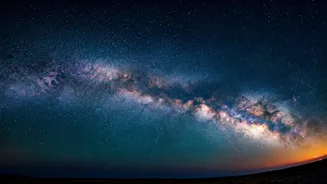
You don't need a telescope or any fancy equipment to be a time traveller. The only tool you need is your own curiosity. Find a spot away from the bright glare of city lights, if possible. Give your eyes about 15-20 minutes to fully adjust to the darkness. You’ll be amazed at how many more stars become visible. You can use a simple stargazing app on your phone to identify major constellations like Saptarishi and Mrigashirsha, or just lie back and appreciate the view.Don’t worry about knowing every name. Instead, pick a single bright star. Think about its distance. Is it ten, a hundred, or a thousand light-years away? What was happening on Earth when the light you are now seeing first left that star? It transforms stargazing from a passive activity into a profound connection with cosmic history.