
Reading the Barcode of a Distant World
To find a potentially habitable planet, astronomers first look for worlds in the 'habitable zone'—the orbital sweet spot where it is not too hot and not too cold for liquid water to exist on the surface. But this is just a starting point. A planet's true
habitability hinges on its atmosphere. Scientists use a technique called transit spectroscopy to peek into these alien skies. When an exoplanet passes in front of its host star from our point of view, a tiny fraction of the starlight filters through the planet's atmosphere. Different gases in that atmosphere absorb light at specific wavelengths, creating a unique chemical fingerprint, like a barcode. By analyzing which 'colors' of light are missing, we can determine what the atmosphere is made of, even from hundreds of light-years away.
The Chemical Hunt for Biosignatures
The ultimate goal is to find 'biosignatures'—gases that point to the presence of life. On Earth, life has filled our atmosphere with a specific mix of gases. One of the most sought-after combinations is oxygen and methane. Oxygen is a highly reactive gas produced in vast quantities by photosynthesis, while methane is often produced by living organisms. Finding these two gases together in a state of 'disequilibrium' would be a powerful clue. This means they are co-existing when they should chemically cancel each other out, suggesting something—like life—is constantly replenishing them. Other potential biosignatures include nitrous oxide and even more obscure molecules like dimethyl sulfide, a gas produced by marine life on Earth.
Beyond a Breath of Fresh Air
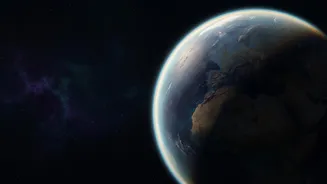
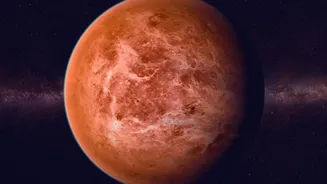
An atmosphere does more than just provide gases to breathe; it acts as a planetary thermostat. The greenhouse effect, driven by gases like carbon dioxide and water vapor, is essential for maintaining stable surface temperatures. Without our atmosphere, Earth's average temperature would be a frigid -18°C. Analyzing an atmosphere tells scientists about a planet's climate. It reveals the presence of clouds, which can reflect sunlight or trap heat, and helps estimate the surface pressure and temperature. Even a planet in the perfect location could be uninhabitable if it has a runaway greenhouse effect like Venus, or if its atmosphere is too thin to hold onto heat, like Mars.
The High-Tech Tools for an Interstellar Search
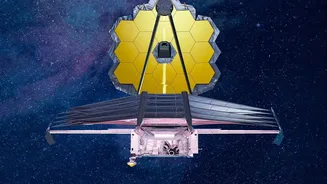
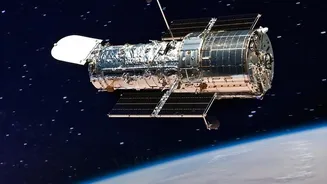
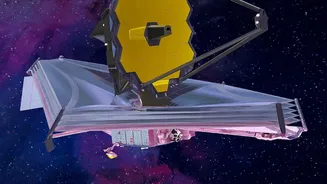
This detailed analysis is only possible thanks to incredibly powerful technology. The James Webb Space Telescope (JWST) has been a game-changer, with its advanced infrared spectrographs capable of dissecting the faint light from exoplanet atmospheres with unprecedented precision. It has already delivered groundbreaking results, confirming the presence of carbon dioxide, water vapor, and swirling silicate clouds on distant worlds. Future missions, like the European Space Agency's Ariel telescope, are being designed specifically for large-scale surveys of exoplanet atmospheres, promising to expand our catalogue of analysed worlds. These tools are moving the search for life from a theoretical exercise to an observational science.
The Challenge of Cosmic False Alarms
The search is not without its difficulties. A potential biosignature is not definitive proof of life. Geochemical or photochemical processes can sometimes mimic the signs of biology, creating 'false positives'. For example, a planet's star emitting high levels of ultraviolet radiation could create an oxygen-rich atmosphere without any life at all. Scientists must therefore act like cosmic detectives, carefully considering the entire planetary context—the type of star, the planet's size, and the combination of different gases—to rule out non-biological explanations before making any grand announcements. This complexity is why finding a robust biosignature requires not just detection, but careful, repeated observation and modeling.