


A Cosmic Masterpiece of Ice
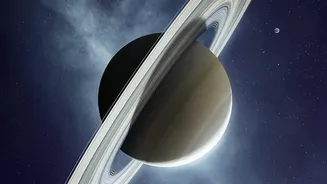
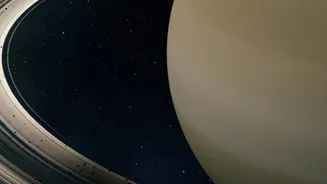
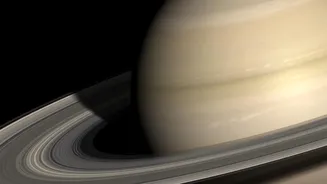
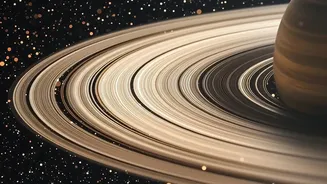
From a distance, Saturn's rings look like a solid, continuous disk of light. But up close, thanks to missions like Cassini, we know they are made of billions of individual particles. The overwhelming majority of this material is water ice, which is why
the rings are so bright and reflective. Sprinkled in are smaller amounts of rocky material and dust. These countless particles orbit Saturn together, forming a structure that is incredibly wide, stretching up to 282,000 kilometres, yet astonishingly thin—in most places, only about 10 meters thick.
The Violent Birth of the Rings
The leading theory for the rings' origin is a story of cosmic destruction. Scientists believe that roughly 100 to 200 million years ago—relatively recently in cosmic terms—a large, icy moon, or perhaps a large comet, wandered too close to Saturn. This hypothetical moon has even been given a name: Chrysalis. Drawn in by Saturn's immense gravity, this body crossed a critical threshold where it could no longer hold itself together. Saturn's gravitational pull tore it apart, shattering it into trillions of icy pieces that then began to orbit the planet.
Saturn's Zone of Destruction
The key to this destruction is a concept called the Roche limit. This is the invisible boundary around a massive body like Saturn where its tidal forces—the difference in gravitational pull on the near and far side of an object—are stronger than the object's own gravity holding it together. Any moon or large body that strays inside this limit will be ripped to shreds. This same force also prevents the ring particles from clumping together to form a new moon. They are trapped in an eternal orbit, destined to remain as individual particles because Saturn's gravity keeps them apart.
A Never-Ending Collision Course
The initial shattering of the moon created the raw material for the rings, including many large fragments. But this was just the beginning. The particles in the rings are in constant motion, orbiting Saturn at incredible speeds. However, they don't all orbit at the exact same speed, leading to a state of perpetual collision. When larger ice chunks knock into each other, they can break apart, creating smaller fragments. This constant grinding process is a major reason for the wide range of particle sizes. Over millions of years, this cosmic rock tumbler has continuously produced a fresh supply of smaller ice and dust particles.
From Dust Grains to Mountain Blocks
This process explains the vast diversity in particle size. The 'dust grains' are the finest product of this endless grinding and also come from micrometeoroid impacts that pulverize the icy surfaces. At the other end of the scale are the 'mountain blocks'. These are not literal mountains, but rather house-sized or even larger chunks, with some estimated to be up to a kilometre across. These giants are thought to be the original, more durable remnants from the initial breakup of the parent moon that have managed to survive the collisional chaos. Thus, the ring system is a living museum, containing both ancient fragments and newly created dust.
The Role of Shepherd Moons
The story doesn't end there. The structure of the rings, including some of their sharp edges and gaps, is maintained by dozens of small moons orbiting within or near them. These are called 'shepherd moons'. Their gravity helps to police the ring particles, nudging stray pieces back into line and preventing the rings from spreading out and dissipating. Some moons, like Pan and Daphnis, orbit within gaps in the rings that they have cleared themselves, constantly interacting with the particles at the edges and creating beautiful, wavy patterns. This gravitational sculpting further sorts and reorganises the particles, contributing to the complex and dynamic system we see today.