






India's ₹6,000 Crore Quantum Bet
In 2023, the Indian government approved the National Quantum Mission (NQM), a landmark initiative with an outlay of over ₹6,000 crore to be spent over eight years, until 2031. This mission isn't just about catching up; it's about creating a vibrant ecosystem
for quantum research, development, and innovation to position India as a global leader in the field. Managed by the Department of Science and Technology, the mission aims to nurture scientific and industrial advancements, making India self-reliant ('Atmanirbhar') in this critical technology. The NQM has established four thematic hubs in leading institutions like IISc Bengaluru and various IITs, each focusing on a core area: quantum computing, communication, sensing and metrology, and materials.
Beyond Computing: Unhackable Communication
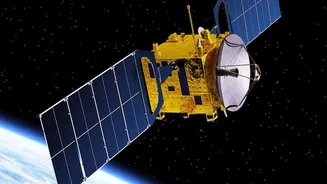
One of the most promising applications beyond computing lies in quantum communication. Imagine a communication network that is physically impossible to hack. This is the promise of Quantum Key Distribution (QKD), a technology that uses the principles of quantum mechanics to secure data. Any attempt to eavesdrop on a quantum channel disturbs the quantum state, immediately alerting the parties involved. The NQM has set ambitious goals in this area, including establishing satellite-based secure quantum communication over a range of 2000 kilometres within India and developing inter-city QKD networks. This technology is vital for protecting critical infrastructure in sectors like defence, banking, and government communications, safeguarding everything from financial transactions to sensitive national security data.
Sensing the Unseen with Quantum Precision
Quantum sensing is another vertical where India is making significant strides. These sensors use quantum properties to measure physical quantities like magnetic fields, gravity, and time with unprecedented accuracy. The applications are revolutionary. For instance, quantum sensors could lead to GPS-free navigation systems, a crucial development for military and civilian transport that would be immune to jamming or spoofing. In healthcare, they could enable highly sensitive medical imaging for earlier disease detection. They can also be used for underground resource mapping to find water or minerals and for developing hyper-precise atomic clocks essential for navigation and communication networks. The NQM is actively supporting the development of these indigenous sensors to meet national needs.
Building the Blocks: Materials and Computers
While the focus is broadening, quantum computing remains a core pillar of the mission. The goal is to develop intermediate-scale quantum computers with 50 to 1000 physical qubits within eight years. Success here depends on the fourth vertical: quantum materials. This involves designing and synthesising novel materials like superconductors and topological materials that are essential for fabricating the components of quantum devices, from computer qubits to photons for communication. These foundational elements are crucial for the entire quantum ecosystem, enabling the development of everything from quantum computers to the single-photon detectors needed for secure networks.
The Road Ahead and Why It Matters
India's quantum journey is ambitious and not without challenges, including the need to build a skilled workforce and translate lab research into market-ready products. However, the progress is tangible. The NQM has already supported promising startups and is fostering collaborations between academia and industry. The mission is a strategic imperative, a move to ensure India is not just a consumer but a creator of the next wave of world-changing technologies. It will drive advancements in healthcare, finance, defence, and energy, strengthening national initiatives like Digital India and Make in India. By investing across the full spectrum of quantum technologies, India is not just building faster computers; it is building a secure and prosperous future.