






The Planet of Geometric Storms
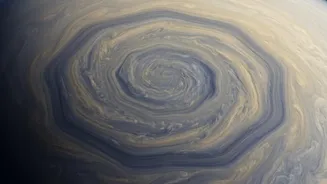
For over 40 years, one of Saturn’s most captivating features has been a massive, six-sided jet stream known as 'the hexagon' circling its north pole. This stable, 20,000-mile-wide pattern has been a long-standing puzzle for planetary scientists. It was
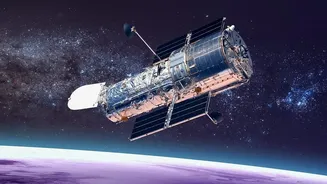
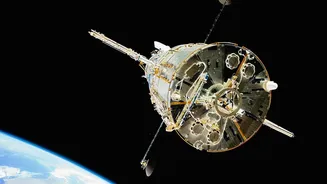
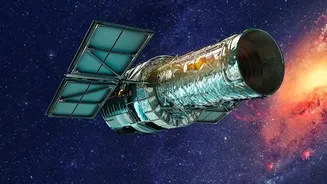
first spotted by the Voyager spacecraft in the 1980s and studied in detail by the Cassini mission. For decades, this atmospheric anomaly appeared to be entirely unique, with no counterpart at the planet's southern pole. That has all changed. Thanks to recent observations from NASA's Hubble Space Telescope, scientists have confirmed a new, enormous, and even more complex pattern emerging at the opposite end of the planet.
Say Hello to the Decagon
The new feature is a massive, 10-sided atmospheric wave, or 'decagon', spinning in the icy ammonia clouds of Saturn's southern polar region. This newly discovered jet stream formation is even larger than the northern hexagon and appears to be more unstable. Lead author Agustin Sanchez-Lavega noted that the discovery was a complete surprise. The south pole was tilted away from Earth's view for over a decade, between 2012 and 2023. As Saturn's long seasons changed, bringing the southern hemisphere back into view, Hubble's Outer Planet Atmospheres Legacy (OPAL) program captured the first definitive images of this decagon in 2023. Researchers believe the pattern likely began to form sometime after 2017, when the Cassini mission ended.
A Tale of Two Poles
While both the hexagon and the decagon are born from powerful jet streams, they have distinct differences. The northern hexagon is remarkably stable and almost stationary. In contrast, the southern decagon is a meandering wave that appears to still be evolving and growing stronger. It also migrates slowly eastward. Computer simulations suggest these polygonal shapes form when curving atmospheric jets become trapped, causing small disturbances to grow into a stable geometric pattern. The fact that Saturn can produce two different polygons suggests this is a fundamental, though poorly understood, aspect of its atmospheric dynamics. According to Sanchez-Lavega, this proves the hexagon is not as singular a feature as once believed.
Why This Discovery Matters
The discovery of the decagon is significant because it provides scientists with a rare opportunity to watch a giant atmospheric pattern develop in real-time. Amy Simon, a senior scientist at NASA, highlighted that having a second example of such a phenomenon allows for comparative study. By observing how the decagon evolves as Saturn's southern summer approaches and solar radiation increases, scientists can learn more about the forces that create and sustain these bizarre weather systems. This research isn't just about Saturn; it provides crucial insights into the meteorology of gas giants in general. Understanding the atmospheric dynamics on Saturn could help explain similar polar cyclones observed on Jupiter and improve models for planets outside our own solar system.