



An Earth-Like World, But Not as We Know It
At a glance, Titan is one of the most Earth-like worlds we have ever discovered. It is the only moon in our solar system with a dense atmosphere, which is primarily made of nitrogen, just like ours. But that's where the familiar ends and the wonderfully
strange begins. The temperature on Titan hovers around a frigid -179 degrees Celsius. Instead of a water cycle, Titan has a methane cycle. Methane and ethane fall as rain from hydrocarbon clouds, carving river channels into the icy surface and pooling in vast lakes and seas, some larger than North America's Great Lakes. This makes Titan the only other place in the solar system known to have stable bodies of liquid on its surface. It's a world with weather, seasons, and geological features like dunes, but all based on materials that would be gases on Earth.
A Chemical Factory in the Sky
Titan's hazy, orange atmosphere is not just a weather engine; it's a massive chemical factory. Sunlight and high-energy particles from Saturn's magnetic field break apart nitrogen and methane molecules in the upper atmosphere. These fragments then recombine to form a complex soup of organic compounds. This process creates a thick, organic smog that obscures the surface. Over billions of years, these complex molecules have been raining down, blanketing the moon in a layer of carbon-rich materials called tholins. These sticky, reddish substances are not found naturally on Earth today, but scientists believe they might be similar to the chemical precursors that existed on our own planet before life emerged. In essence, Titan could be a frozen snapshot of the prebiotic Earth, offering a unique chance to study the building blocks of life.
A Hidden Ocean of Water
While Titan's surface is far too cold for liquid water, evidence from NASA's Cassini mission strongly suggests that a vast ocean of liquid water exists deep beneath its icy crust. This subsurface ocean, possibly mixed with ammonia which acts as an antifreeze, could be up to 250 kilometres deep. The discovery of this hidden ocean fundamentally changes our view of Titan. It means the moon has two distinct environments where life-related chemistry could occur: the hydrocarbon-rich surface and a dark, liquid water world below. The possibility of water interacting with the complex organic materials on Titan, perhaps where an asteroid impact has melted the crust, is particularly exciting for astrobiologists. Such an event could create a temporary, warm, nutrient-rich pond, a potential crucible for prebiotic chemistry.
Enter Dragonfly: The Flying Explorer
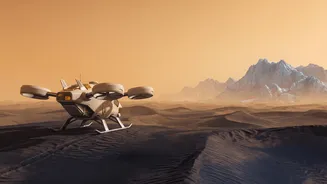
To investigate this remarkable world up close, NASA is sending a revolutionary mission called Dragonfly. Scheduled to launch in July 2028 and arrive in 2034, Dragonfly is a nuclear-powered, car-sized rotorcraft—essentially a dual-quadcopter drone. Taking advantage of Titan's high atmospheric density and low gravity, Dragonfly will be able to fly from one location to another, covering more ground than any wheeled rover ever could. Its primary mission is to explore diverse environments, from the organic dune fields near its landing site, Ahmakiq Undae, to the Selk impact crater. Scientists believe the Selk crater is a place where liquid water, organic materials, and energy were once mixed, providing a prime target to search for complex molecules and assess Titan's potential habitability.