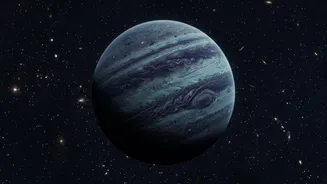








A Cosmic Disappearance
Imagine the excitement: astronomers detect a faint, periodic dip in the light of a distant star, a tell-tale sign that a planet is orbiting it. This candidate, perhaps named something like TOI-2535 b, appears promising. It’s the right size, its orbit is stable,
and it’s located in a fascinating star system about 1,000 light-years from Earth. The discovery process begins, and the world is one step closer to adding another pin to the vast map of known exoplanets. But then, upon a 'closer reading' with more powerful instruments, the signal disappears. The planet is gone. This scenario, while dramatic, is a surprisingly common and crucial part of the scientific process. The 'missing' planet was never truly there to begin with; it was a ghost in the data, a cosmic illusion.
The Art of Planet Hunting
Most exoplanets are discovered using the transit method, the very technique that produces these initial, promising signals. Missions like NASA's Transiting Exoplanet Survey Satellite (TESS) stare at hundreds of thousands of stars, measuring their brightness with incredible precision. When a planet’s orbit takes it directly between its star and our telescopes, it blocks a tiny fraction of the starlight, causing a minuscule, temporary dip in brightness. If these dips happen with predictable regularity, astronomers flag the star as having a 'planet candidate'. This initial detection is the first step in a long journey of verification. It's an educated guess based on a pattern, but it's not yet a confirmed discovery. The universe is full of phenomena that can mimic this planetary signature.
When a Planet Isn't a Planet
So, what can create the illusion of a planet? The most common culprits are eclipsing binary star systems. These are systems where two stars orbit each other. If our line of sight is just right, they will periodically eclipse one another, causing a dip in brightness. Sometimes, a faint pair of eclipsing binaries is located in the background, directly behind the brighter star being observed. The light from all three stars blends together in the telescope's view. When the faint background stars eclipse each other, the overall dip in the blended light can be small enough to perfectly mimic the signal of a transiting planet. This is known as a 'blended eclipsing binary' and is a classic type of astronomical false positive.
The Detective Work of Astronomy
Confirming a planet candidate requires rigorous follow-up observations. Astronomers use a battery of tests to rule out false positives. They might use more powerful ground-based telescopes to get a clearer view, checking if any faint background stars are hiding in the same pixel of the original observation. They also use different methods, like the radial velocity technique, which looks for the gravitational 'wobble' a planet induces on its host star. An eclipsing binary in the background wouldn't cause the target star to wobble. Another technique involves observing the system in different colours of light. A real planet will block the same percentage of light regardless of colour, but the light from a blended eclipsing binary can cause the dip to change depth at different wavelengths, exposing the impostor.
A Triumph of the Scientific Method
It might feel disappointing to 'lose' a planet like TOI-2535 b, but every false positive identified is actually a major success for science. The goal of exoplanet hunting isn't just to rack up numbers, but to build a reliable and accurate census of the worlds beyond our solar system. By weeding out the impostors, scientists strengthen our confidence in the planets that are confirmed. This careful vetting process refines their techniques and deepens their understanding of the universe's complexities. It ensures that when a planet is officially announced, especially a potentially habitable one, the evidence is as solid as possible. The story of a missing planet isn't a tale of failure; it's a testament to the self-correcting nature of science that makes discovery possible.