


Vrikshasana, or Tree Pose, is a cornerstone of yoga that builds balance, strengthens the legs, and calms the mind. Its power lies in its simplicity and the steady focus it requires. Ready to deepen your practice? Explore these variations.
The Foundation: Classic Tree Pose
Before exploring
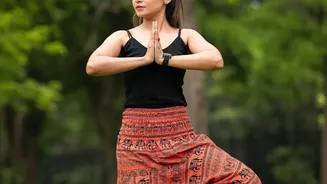
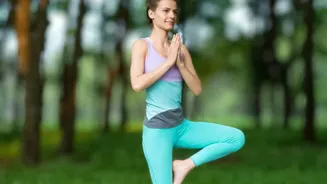
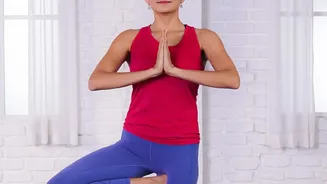
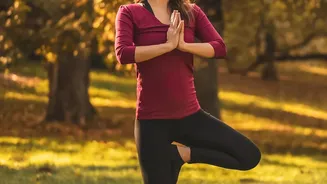
the branches, you must establish strong roots. Start in Mountain Pose (Tadasana), standing tall with your weight evenly distributed. Shift your weight onto your left foot and bend your right knee. Place the sole of your right foot on your inner left ankle, calf, or thigh, using your hand to guide it if needed. A critical rule is to always avoid placing the foot directly on the knee joint, as this can cause injury. Press your foot into your standing leg and your leg back into your foot to create a stable connection. Find a 'drishti', a fixed point to gaze at in front of you, to help maintain your balance. Bring your hands to a prayer position at your heart. Hold for 30-60 seconds, breathing steadily, before repeating on the other side.
For Stability: Assisted and Beginner Variations
If you feel wobbly, there are many ways to find support. The easiest modification is to keep the toes of your lifted foot on the floor, with the heel resting against your standing ankle. This gives you a point of contact while you get used to the single-leg balance. Another excellent option is to use a wall or a sturdy chair for support. Stand beside a wall and rest a hand lightly against it to steady yourself as you lift your leg. This removes some of the balance challenge, allowing you to focus on proper alignment and building strength in your standing leg.
Growing Your Branches: Exploring Arm Variations
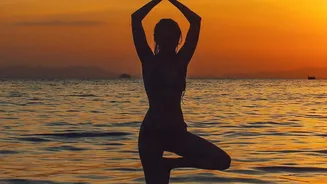
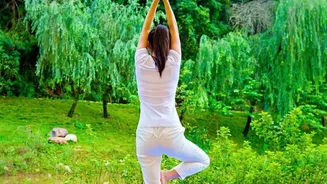
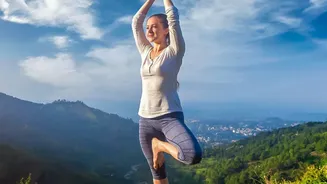
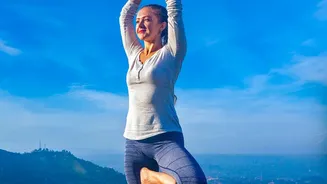
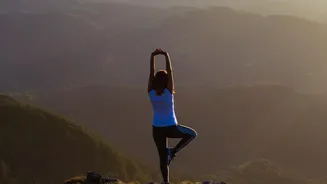
Once your foundation feels solid, you can begin to play with the expression of your 'branches'. The classic arm position is Anjali Mudra (prayer hands) at the heart, but it's not the only option. Try extending your arms straight overhead, palms facing each other or touching. This variation lengthens your spine and challenges your balance by raising your center of gravity. You can also open your arms out to the sides like the branches of a tree, or even create a gentle, swaying motion with them to mimic a tree in the wind, which adds a dynamic balance challenge.
A Deeper Opening: Half-Lotus Tree Pose
For those with more flexibility in their hips, the Half-Lotus Tree Pose (Ardha Padma Vrksasana) offers a deeper stretch. From your base pose, bring your lifted foot to rest on the opposite hip crease, with the sole of the foot facing the sky. This requires significant external rotation in the hip. Allow the knee of the bent leg to drop downwards, but never force it. This variation intensifies the hip-opening aspect of the pose while demanding greater stability and focus. Keep your drishti steady and your core engaged to maintain your balance.
The Next Challenge : Tree Pose with a Side Bend
Adding a lateral bend to your Tree Pose creates a significant new balance challenge and a wonderful side body stretch. Once stable in your Tree Pose with arms overhead, begin to lean your torso to the side of your lifted leg. For example, if your right leg is lifted, you will bend to the right. You can keep both arms reaching or lower one arm down as the other reaches up and over. This movement shifts your center of gravity, forcing the small stabilizing muscles in your standing leg and core to work harder to keep you upright.
An Internal Challenge : Closing Your Eyes
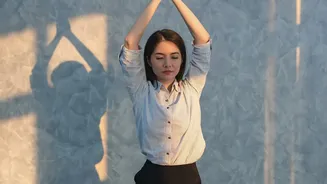
Perhaps the most deceptively difficult variation involves no complex movements at all. Once you feel stable in any version of Tree Pose, try closing your eyes. You will immediately notice how much you rely on your vision for balance. Removing your drishti forces you to rely on proprioception—your body's internal sense of its position in space. It is a powerful way to deepen your inner awareness and concentration. Be sure to practice this near a wall for safety, as it is common to wobble or fall when first attempting it.